

Dubai Harbor woke early on Sunday as the first day of the Future Blockchain Summit x Fintech Surge 2025, co-located with Expand North Star, kicked off under the hood of the Dubai Chamber of Digital Economy, powered by GITEX GLOBAL.
A DJ near the entrance. A wandering mascot. Coffee, snacks, and chatter circulated through the crowd. The energy was buzzing. Startup booths lit up as crypto and fintech minds converged, with discussions being held on how decentralization might finally move from concept to infrastructure.
Startups walked audiences through their products, demonstrating live: some held impromptu gatherings in open zones. Everywhere you looked, you saw the ecosystem in motion: curiosity, momentum, and cautious optimism.
The formal opening of Expand North Star was led by Sheikh Mansoor bin Mohammed bin Rashid Al Maktoum, Chairman of the Dubai Ports and Borders Security Council, who praised the event as a catalyst for global startup growth, connectivity, and innovation.
Solana’s case for decentralized finance
The day’s opening session, “Enabling Internet Capital Markets: Solana’s Role in a Decentralized Financial Future,” brought Lily Liu (President of the Solana Foundation) and Viktor Fischer (Founder & CEO of RockawayX) together to unpack how Solana can serve not just as a trading base, but also as a new financial paradigm.
Lily and Viktor didn’t shy away from addressing recent turbulence. The 2 a.m. market crash, caused by headline shadowing tweets from Donald Trump, revealed weaknesses in traditional and blockchain systems alike. In addressing that, Viktor noted that an estimated $20 billion was wiped out, with centralized exchanges like Binance encountering liquidity stress and missing long positions in the order books. In contrast, Solana maintained high throughput (100,000 transactions per second) even under strain.
Video: Find out what happened at the summit
Lily recounted how other popular networks’ congestion drove transaction fees to around $1,500 in extreme cases, whereas Solana saw only a peak of $4. This indirectly made a strong statement for the network’s design, as low-cost, high-speed, and scalable smart contracts make it better suited for real-world financial use cases. And, so a case was made: a singular, foundational blockchain layer capable of supporting 5.5 billion users, where capital markets, tokenization, payments, and more live natively on-chain.
Tokenized equities
They touched on what’s valuable: asset issuance on-chain, stablecoins, P2P transfers, and cross-border financial flows. Lily flagged a key tension: memecoins driving a major chunk of price action on one end of the spectrum while real-world assets (RWAs) experience high stability on the other end. The “sweet spot”, therefore, lies in tokenized equities that combine price volatility with underlying value.
They also pushed back on one of crypto’s most infamous questions: fundamental value. Usage of the chain, base fees, priority fees, and staking economics must form a coherent narrative for long-term sustainability. Lily brought more focus on holding and usage models, beyond just speculative cycles. As for institutional adoption, she noted that ETF launches were imminent, with “physically staked” products expected to expand access.
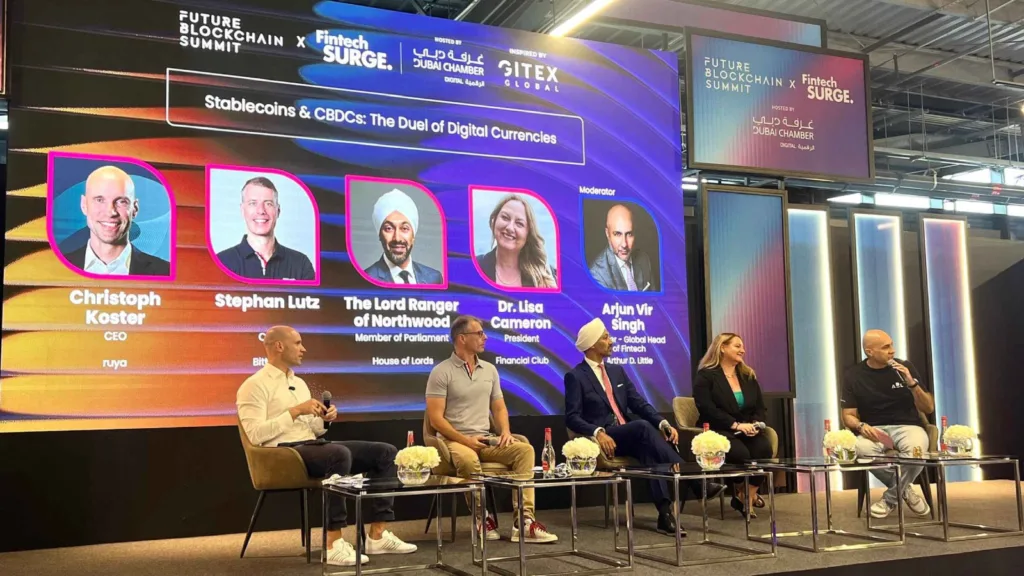
Stablecoins and CBDCs: The duel of digital currencies
The second major session of the day tackled the question of whether central banks or private innovators will define the future of digital money.
On stage were:
- Christoph Koster, CEO of ruya
- Stephan Lutz, CEO of BitMEX
- The Lord Ranger of Northwood, Member of the UK House of Lords
- Lisa Cameron, President of the Financial Club UK
- Arjun Vir Singh, Global Head of Fintech at Arthur D. Little.
Together, they explored the delicate balance between stability, sovereignty, and innovation as digital currencies move from concept to global reality.
The panel agreed that the competition between stablecoins and central bank digital currencies isn’t really a fight, but more like a test of trust and education. Most people still don’t understand how digital money works, and they felt that building awareness is just as important as building the tech itself.
Lord Ranger and Lisa Cameron brought up the need for governments to create trust through transparency and public education. They noted that regulation and collaboration between policymakers will determine how quickly citizens adopt digital currencies. Stephan Lutz drew a clear line between the two systems: stablecoins are open, permissionless, and global, while CBDCs will likely stay centralized and limited by borders. Christoph Koster, meanwhile, pointed to the UAE’s momentum, noting that local adoption and market-driven innovation are already proving what’s possible.
There was also a geopolitical undertone. The US leans toward stablecoins for market efficiency, while the UK and others see CBDCs as tools for oversight and national utility. Arjun Vir Singh summed it up pretty neatly: the coming years will be about bridging both worlds, not choosing sides.
The world is moving toward programmable money, and whether driven by regulators or innovators, it will only work if people trust it.
DeFi risk management in a post-crisis world
Later in the day, the tone shifted from vision to vigilance under the panel on “DeFi Risk Management in a Post-Crisis World.” This conversation explored the cracks exposed in recent cycles: smart contract exploits, insider trades, sentiment manipulation, and the line between centralized and decentralized models.
It brought forth a powerhouse lineup:
- Jimmy Zhigang Su, Chief Security Officer at Binance
- Joseph Ziolkowski, CEO and Founder of Relm Insurance
- Vugar Usi Zade, COO of Bitget
- Nikita Sachdev, Founder and CEO of Luna PR, who also moderated the session.
The conversation once again opened with the lingering impact of the biggest liquidation event in crypto history. The speakers agreed that the crisis revealed how fragile parts of the system still are, not because of smart contract failures alone, but because of insider moves that can swing markets faster than any technical glitch.
There was a shared sense that DeFi and centralized exchanges are no longer rivals but complementary systems. Centralized platforms offer governance, segregation of funds, and protection mechanisms, while DeFi provides unmatched transparency and automation. The future, according to the speakers, lies in hybrid models that combine centralized oversight with decentralized verification, where users retain visibility but also have safety nets if things go wrong.
Security and risk literacy
The situation of everyday users came up repeatedly. Hacks and wallet compromises remain daily happenings, and while defi’s transparency helps, poor recovery practices and social engineering still make for the most losses. They agreed that better security protocols, not just smarter contracts, will make the next phase of trust.
AI also made its way into the discussion. The panel saw potential in AI-powered analytics and automation but acknowledged its double-edged risk. Without model verification or data transparency, AI could introduce new systemic risks even if it boosts efficiency.
In closing, the panel agreed that DeFi will only become truly safe when users adopt stronger security habits and builders prioritize risk management as part of design, not as an afterthought.
The ecosystem in motion
The rest of the day was as alive offline as on. The expo halls could be seen filled with booths from crypto infrastructure providers, AI + fintech startups, on-ramp services, wallet providers, and tokenization projects. Founders, investors, engineers, and enthusiasts roamed the floor, pitching, networking, and debating.
As Day 1 closed, some questions hung in the air:
- Can hybrid governance models in DeFi scale while preserving real decentralization?
- Is there potential for tokenized RWAs to find deeper liquidity and the credibility to attain utility?
- How will regulators across jurisdictions balance consumer protection with space for experimentation?
- Can DeFi utilize AI to become transparent and auditable or will it introduce more risk?
The progression of blockchain technology is gradually giving way to the possibility of embedded finance. The optimism is still there, but also met with concerns about risk and real-world adoption. Perhaps, as the days progress, there will be more light shed on the future of the industry.