

The birth of a new Pi sparks an old identity crisis, as the crypto world woke up to another Pi Squared headline, and within minutes, social media did what it does best: panic and misinterpret.
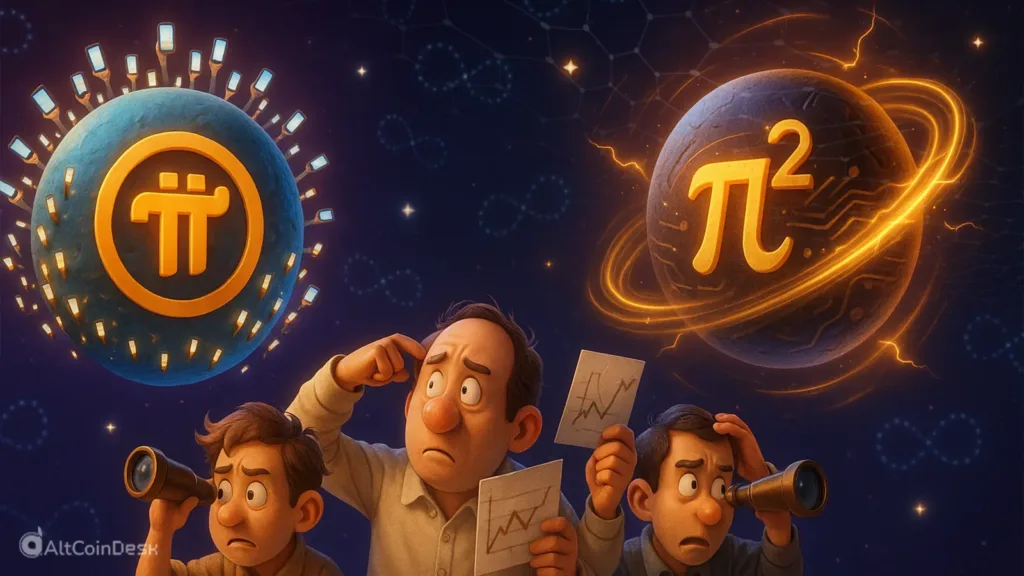
Wait, is Pi Network rebranding? Or is this an upgrade to Pi 2? The big question on everyone’s mind. The truth, of course, is that Pi Squared and Pi Network are about as related as an iPhone and a telescope. They share a name, not a mission.
Two PIs, two philosophies
Let’s set the record straight.
- Pi Network is the mobile-mining app millions of users have tapped daily since 2019. It built a community around accessibility, promising to democratize crypto by allowing anyone to mine its native coin, Pi, directly from a smartphone. Think of it as the social experiment that proved crypto can live in your pocket.
- Pi Squared, on the other hand, launched Devnet 2.0 today, a high-performance test environment for its FastSet protocol, an ambitious system designed to make decentralized payments run at internet speed.
While Pi Network focuses on inclusion, Pi Squared is chasing scalability. Its team, led by computer scientist Grigore Roșu, claims the network already processes 150,000 transactions per second with sub-100 millisecond finality, targeting 1 million TPS by 2026. That’s not just fast; that’s almost sci-fi fast.

Why the confusion exists: Pi Squared vs. Pi Network
To the casual observer, both names seem to orbit the same planet. “Pi” is a beloved symbol in tech culture, a nod to infinity, logic, and circles of trust. Both projects live in the Web3 universe, and both talk about decentralization. But the similarity ends there.
Pi Network is consumer-facing, built around a social graph of miners. Pi Squared is infrastructure-level, aiming to power cross-chain payments and verifiable computing through parallel transaction processing. One runs on community consensus; the other runs on mathematical concurrency.
Yet in crypto, branding confusion travels faster than confirmation. The Pi Squared website went live with its Devnet 2.0 launch this morning, and within hours, Pi Network groups were buzzing with speculation. A few opportunistic posters even claimed the two had “merged,” an easy trap when names rhyme and tokens don’t yet trade on major exchanges.
Parallel ambitions, perpendicular directions
There’s a poetic irony here. Both PIs want to make crypto mainstream: one through participation, the other through performance.
- Pi Network represents the dream of accessibility, letting millions mine coins without the cost of hardware or electricity. Its goal is social adoption first, economic validation later.
- Pi Squared, meanwhile, speaks to developers and institutions. Its FastSet protocol processes transactions in parallel rather than sequentially, eliminating the bottlenecks that slow traditional blockchains. It’s the kind of technology layer you’d expect under the hood of future financial networks, not a smartphone app.
If both succeed, they could serve different layers of the same ecosystem: Pi Network as the onboarding gateway and Pi Squared as the invisible engine that makes transactions instant. But for now, their paths remain distinct, and any claim of connection should raise eyebrows.
The confusion between Pi Network and Pi Squared isn’t malicious but a symptom of a fast-moving industry where attention outruns understanding. Also, it highlights how branding clarity and transparent communication will decide who earns real trust in the next Web3 cycle.
Pi has now been squared
Pi Squared is not a sequel to Pi Network. It’s an entirely separate project aiming to redefine the infrastructure of Web3 payments. One builds a community; the other builds the rails that the community will one day use. Both matter. But for anyone mining Pi on a phone and wondering whether today’s launch means a system upgrade, sorry, wrong Pi.