

The crowd had evolved into a true community. Conversations flowed effortlessly, and collaborations came together faster than ever. It was the final day of the Future Blockchain Summit x Fintech Surge at Dubai Harbour.
Amid the buzz, one theme stood out: the future of decentralized finance will be defined by stablecoins, central bank digital currencies (CBDCs), and regulation.
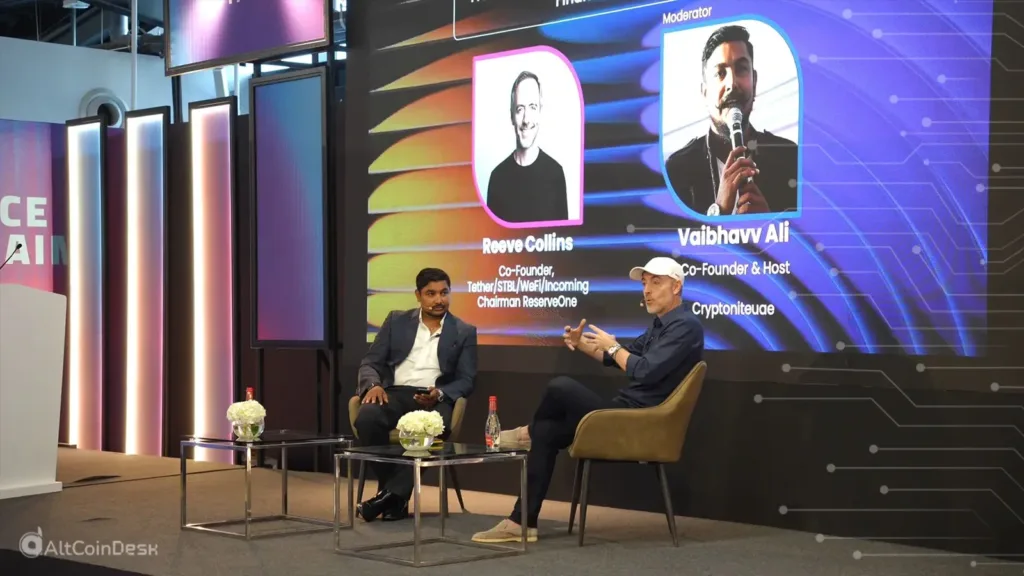
On the main stage, a crowd gathered for one of the day’s most anticipated sessions: ‘From the First Tokenized Dollar to the Next Global Financial Ecosystem’. Sitting across from each other were:
- Reeve Collins, co-founder of Tether
- Vaibhavv Ali, co-founder of Cryptonite UAE.
Collins spoke with the casual authority of someone who has seen it all. “Tokens and blockchain provide global connectivity,” he said. “Stablecoins give access to people who didn’t have access to a financial ecosystem before.” He explained how, in the early days, centralized entities reaped all the benefits of the ecosystem. “The concept of wallets and tokens changed all that,” he said. “Now we have bespoke companies built with communities first.”
The stablecoin’s dilemma
At its core, a stablecoin is digital money that aims to value itself at one dollar. Behind the scenes, it is backed by real assets such as cash, bonds, or even other cryptocurrencies. Traders and algorithms work constantly to keep its price balanced. They serve a purpose of being the bridge to DeFi, powering smart contracts, enabling instant settlement, and letting users move value across blockchains without the wild swings of crypto volatility.
But stability comes with its own challenges. Transparency, de-pegging risks, and regulatory concerns still hang over the sector. The fall of algorithmic models like TerraUSD showed how fragile confidence can be. Meanwhile, governments worldwide are exploring CBDCs, which could either complement or compete with stablecoins. Some predict coexistence, where CBDCs serve as the settlement backbone and private stablecoins operate on top. Others believe central bank coins could replace them entirely.
A trip down memory lane
The first stablecoin project, Tether, is now seen as the pinnacle in the market. Looking back, Collins reflected on Tether’s early days. “It used to be called Realcoin,” he smiled. “It was real-world money, real-world dollars on the blockchain…but the concept of tethering the dollar to the blockchain made sense.”
He moves on to address the ambiguity of regulation at the time. “It was navigating a minefield…it was a very grey area,” he said. “There weren’t any laws…The stakes were significant. People were going to jail.” he stated, before setting the premise: “Today, if you’re in the grey area, you feel safe enough to operate because they’re not coming after you to put you in jail.”
Addressing the recent explosion of stablecoin projects that happened as a result of the U.S. opening “the floodgates”, Collins seemed confident that it will lead to more credibility. Ecosystems want stablecoins because they’re profitable and if done properly, that profit can be shared with the ecosystem community, allowing it to be more “efficient” than the traditional banking system.
Stablecoin 2.0: How can the next generation stand out?
According to Collins, what makes a stablecoin project successful is dependent on a few key factors:
- Reliability – It has to be backed and pegged 1:1 to the dollar.
- Collateral on chain – Progressive tokenization of traditional assets leads to increased utility allowing for higher returns for the same risk
- Ecosystem – Companies with large, active user bases will dominate because distribution and access are everything.
“It’s straightforward. Give me a dollar, I’ll give you a token back. All stablecoin companies make money on the interest,” he said. For Collins, the next phase of evolution is clear: a second generation of stablecoins that will allow people who put value into the ecosystem and mint tokens to reap the rewards, flipping the model. “But now, the people who put value into the ecosystem and mint them will reap the benefits.”
With on-chain treasuries, he added, users no longer need to rely on the stablecoin company itself as on-chain banks eventually become the foundation. Collins predicted that users won’t need a crypto wallet and a separate banking app. In its place will be a unified platform that acts as a decentralized bank where users are rewarded for using its services. “Soon you’ll see system-specific stablecoins. You’ll start seeing currencies named after companies and ecosystems.”
The shadow of the CBDC
“If you are the government, then CBDCs are the best thing to ever happen to your country. If you’re a citizen, the CBDCs are the worst thing to ever happen to your country.” Moving onto the utilisation of the digital currency, he states as it adds complete control, efficiency, and transparency of the monetary system, but at the cost of privacy and censorship-resistance.
On the path of innovation
For founders entering the space, his advice was simple. “Launch a great product, not a token. Operate with integrity. Even if your project fails, you won’t be seen as a scammer.”
Consumers, on the other side, will first choose stablecoins the way they choose savings accounts based on what they value most. “Do you want gold? Or do you want Euros?” At first brand will matter, but as AI gets implemented, the transactions and financial decisions will transform into activity taking place between AI agents. “You won’t care who issues it, only that it works.”
As the session wrapped, one could tell that the applause didn’t just communicate appreciation, but also recognition of how far digital money has come. An ideal has been formed: humanity could be witnessing the transition of DeFi going from its first tokenized dollar to the possibility of a fully on-chain, AI-powered financial ecosystem.