

“WLFI unlocking 62B tokens” sounds like a liquidity event. It really is not.
At first glance, it looks like a massive release of tokens into the market. But once you look closer, it becomes clear that this is something much more deliberate. What is actually happening is a carefully controlled and delayed restructuring of power inside one of the most debated ecosystems in crypto right now.
The proposal introduces a clear vesting structure. It pushes insiders to accept a sacrifice through token burns. It also quietly separates passive holders from those who are genuinely committed. Timing matters here. This move comes right after governance criticism, investor disagreements, and a sharp drop in price that pushed WLFI to new lows.
WLFI to unlock 62B tokens while burning supply sounds simple on the surface. In reality, it sits on top of a deeper tension around control, governance influence, and investor trust.
So the real question is not whether WLFI unlocking 62B tokens is bullish or bearish. The real question is this: Is WLFI tightening supply or tightening control?
What “WLFI unlocking 62B tokens” actually means
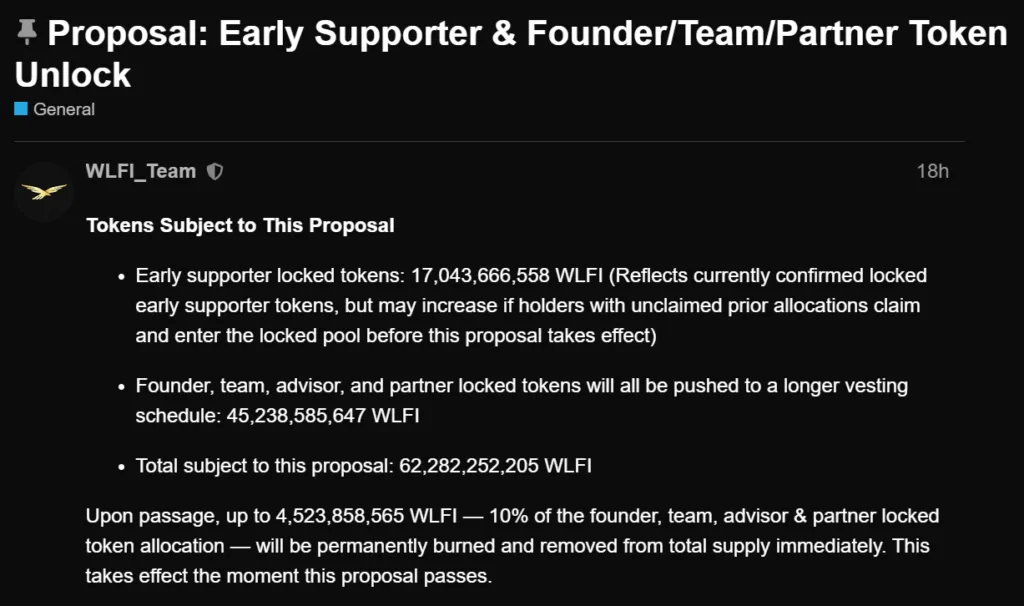
Let’s slow the conversation down and look at what is really happening. The phrase “WLFI to unlock 62B tokens” refers to a governance proposal covering about 62.28 billion locked WLFI tokens. That number is correct, but the assumption that they are about to hit the market is not.
Instead, the tokens are being reorganized across two groups.
- Early supporters hold about 17.04 billion WLFI.
- Founders, team members, advisors, and partners hold about 45.24 billion WLFI.
Now here is where things become more interesting. Early supporters move into a two-year cliff, followed by a two-year gradual release. There are no penalties attached. No tokens are burned. It is simply delayed access.
Insiders, on the other hand, are given tougher terms. They face a two-year cliff followed by a three-year release period. They also accept a mandatory ten percent burn if they choose to opt in. That translates to as much as 4.52 billion WLFI permanently removed.
So yes, WLFI to unlock 62B tokens is technically correct. But it comes with a long timeline and a condition attached to participation. There is one detail that changes everything. If holders do not opt in, their tokens remain locked with no clear exit.
The hidden design: This is not just an unlock
At first glance, WLFI unlocking 62B tokens looks like a supply event. In reality, it behaves more like a filter. Every major holder is forced to make a decision. Accept stricter vesting and a burn, then gain access over time. Or reject the terms and remain locked without a defined unlock path.
This creates a clear divide. On one side are holders who are willing to commit for the long term. On the other side are those who may not be ready to make that decision. This is not typical tokenomics. It is closer to governance engineering.
The WLFI team has already pointed out that only about 23 percent of the affected supply has ever taken part in governance. That leaves roughly 77 percent inactive. So WLFI to unlock 62B tokens is not just about supply. It is about forcing clarity across the ecosystem.
Why now? The timing matters
Moves like this rarely happen without pressure building first. The timing of WLFI’s unlocking of 62B tokens is in line with three big events.
- First, investors are angry and making claims about tokens that are frozen or limited. These stories tend to stick even when they are challenged.
- Second, there was a reported $75 million loan linked to WLFI-related businesses. This brought up issues with collateral, openness, and risk management in general.
- Third, prices are weak. WLFI fell to about 0.078 dollars, which is its lowest level so far.
This doesn’t look like a normal update when you put it all together. WLFI to unlock 62B tokens looks more like a response to pressure.
The burn narrative: Signal or strategy
The burn is the most attention-grabbing part of the proposal. Up to 4.52 billion WLFI were removed from the supply. On paper, that sounds bullish. But context matters. The burn applies only to insiders. It only happens if they opt in. It represents a relatively small portion of the total affected supply. So what is the real message here?
On one level, it shows insiders are willing to give something up. That can be seen as a sign of commitment. On another level, it feels like a step toward repairing trust.
This is not the first time WLFI has talked about burns. A previous governance decision promised that all treasury liquidity fees would go toward buybacks and burns. Some community members later questioned whether that was fully carried out. This time, the burn happens upfront, not later. That choice feels intentional.
Market structure impact: No immediate sell pressure
The biggest fear around any unlock is dilution. But WLFI to unlock 62B tokens does not create immediate selling pressure. There are a few reasons for that. No tokens unlock for two years. Distribution happens gradually over four to five years. Participation depends on holders choosing to opt in. This removes the typical sudden sell-off scenario.
Instead, the market gets a more predictable supply schedule and less uncertainty around timing. From a structural point of view, this looks closer to long-term vesting seen in private markets than what is usually seen in crypto.
Governance power: The real prize
It is easy to focus on supply and forget what WLFI really represents. It is not just a token. It is a governance tool. And WLFI unlocking 62B tokens reshapes how that power is distributed.
By forcing participation decisions, the system begins to identify who actually wants influence. It also reduces uncertainty around inactive large holders. But there is another side to consider.
If large holders opt in and eventually unlock, influence could become more concentrated. So this does not remove centralization risk. It simply changes its structure.
The USD1 angle
WLFI is closely tied to USD1, its stablecoin ecosystem. That connection is important. USD1 has been positioned as a growing stablecoin with proof of reserves and multi-chain presence.
WLFI sits at the center as the governance layer. So WLFI to unlock 62B tokens is not only about token supply. It affects who controls decisions around treasury use, ecosystem direction, and stablecoin expansion. In simple terms, it influences who gets to steer what comes next.
Technical outlook: What happens next
From a market perspective, WLFI is at a turning point. The price recently touched around 0.078 dollars. Sentiment remains fragile. The narrative is still contested.
If WLFI’s plan to unlock 62B tokens is seen as a move toward discipline and transparency, it could support short-term recovery and improve perception. If it is seen as delayed dilution or tighter control, then any rallies may struggle to hold.
The most likely outcome is a period of sideways movement while the market waits for confirmation. That includes governance results, burn execution, and signs of real adoption.
The real question: Control or commitment
When everything is stripped down, WLFI to unlock 62B tokens comes back to one tension. Is this about aligning incentives or controlling outcomes?
The answer is not simple. The burn shows commitment. The vesting adds discipline. The opt-in structure filters participants. At the same time, it introduces pressure, limits flexibility, and reshapes who has influence. That is why opinions are split.
Final take on WLFI 62B tokens unlock
WLFI to unlock 62B tokens is not a straightforward bullish or bearish signal. It is a reset. A way to bring structure to governance, respond to criticism, and define a clearer path forward.
But resets always come with trade-offs. You gain clarity. You lose some flexibility. You reduce uncertainty. You also expose underlying tensions. Right now, WLFI sits right in the middle of that shift.