



Bitwise Asset Management launched an Avalanche (AVAX) spot Exchange Traded Product (ETP) to give its customers exposure to AVAX tokens. The launch of this exchange-traded fund happens at a time when the coin is testing its local resistance level of $9.5 for the sixth time in the space of just 2.5 months. Unlike the spikes of excitement with which AVAX tested this level at other times, this occasion seems to have momentum building behind it.
Bitwise plans to stake fund under its on-chain solution arm
Bitwise Asset Management, a US-based investment company, launched an AVAX spot ETF. The BAVA ETF – the proposed ticker for the ETF will be staked in Bitwise on-chain solutions.
‘Bitwise intends to stake the Fund’s Avalanche (AVAX) holdings through its in-house staking division, Bitwise Onchain Solutions, aiming to carefully preserve liquidity while maximizing participation in Avalanche’s average staking rewards of 5.4%,’ stated the official blog.
“Avalanche is emerging as one of the leading platforms for businesses, governments, and real-world use cases,” said Matt Hougan, CIO of Bitwise. “Avalanche’s unique structure, which lets users leverage the security and scale of a large network while maintaining flexibility and control, makes it a great landing pad for enterprise-grade onchain applications. With BAVA, investors can gain exposure to an asset that we believe is powering the next wave of blockchain adoption across global finance and enterprise.”
Avalanche is a high-performance blockchain designed to enable enterprises and developers to build custom, interoperable networks tailored to specific use cases. These blockchains give institutions the freedom to define their own rules around governance, permissions, and access, while still benefiting from Avalanche’s fast transaction speeds, near-instant settlement, and low fees.
Due to its market cap that stands at approximately $4.1 billion, Avalanche is recognized as a fairly mature digital asset within the industry.
FIFA builds digital collectibles on Avalanche Network
The platform already finds its use in various practical implementations. For example, FIFA has developed its own blockchain powered by Avalanche that allows football fans to exchange digital collectibles. This includes potential access to tickets for the 2026 World Cup.
Even the government has utilized the network in the United States. On the one hand, Wyoming has created its Frontier (FRNT) stablecoin on the Avalanche network, becoming the first U.S. state to issue a stablecoin.
New Jersey State, for example, is considering the use of blockchain technology for the purposes of certification and business licensing within the scope of their initiative entitled ‘Balcony.’ Internationally, Toyota Company is an example of large enterprises interested in Avalanche technology.
In terms of institutional involvement, some firms, including KKR, Apollo, SkyBridge, and BlackRock, have begun utilizing Avalanche technology for tokenization purposes. Furthermore, global stablecoin projects are increasingly utilizing Avalanche technology. Some examples include Japan’s regulated JPYC and Korea’s KRW1.
AVAX tests local resistance for 6th time with better momentum
The launch of the ETF comes at a time when the AVAX prices are testing the resistance level at $9.70 for the sixth time within the last two months. Since February, the token has been testing this level, and it was able to break above the level and reach $10.50 just once.
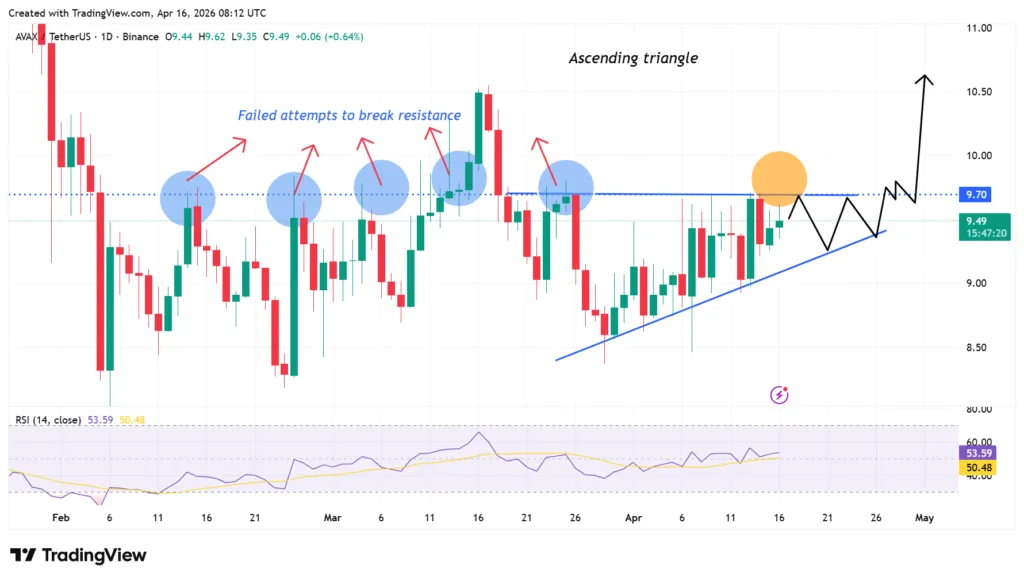
The rest of the attempts were futile as the sellers were fiercely defending this level. AVAX is once again testing this resistance level as it trades inside the ascending triangle.
An ascending triangle is a bullish continuation pattern where price moves diagonally upwards in a zigzag pattern inside a tightening structure with a flat resistance level on top and rising higher lows below.
It often emerges during a bullish trend or a period of recovery, where buyers are slowly getting stronger, although sellers are trying to defend a critical price level.
In reality, inside the triangle, there is a gradual change of control. Every time that the price is met by resistance, the sellers drive it lower, but the retracement becomes increasingly smaller because buyers start to intervene at higher prices than the previous lows.
This leads to the formation of a series of higher-low formations, indicating a growing number of buyers. On the other hand, the level of resistance stays constant, which shows a high concentration of supply on one level only, despite rising demand underneath.
Traders behave differently during this phase. Some accumulate the dips and expect a breakout, while sellers continue to take profits at the resistance zone. Traders who follow the patterns usually wait for confirmation above resistance for a breakout before they enter.
Meanwhile, short sellers may attempt to fade the top, expecting another rejection. As the pattern develops, volatility often compresses and the range of motion contradicts because neither side fully takes control, and liquidity builds up on both ends of the range.
If buying pressure continues to strengthen as the pattern forms, the market breaks above the resistance level. This breakout is often sharp because it triggers stop losses from short positions and brings in momentum buyers at the same time.
Put it simply, an ascending triangle represents a situation where the bullish momentum or the demand builds when the supply is fixed or the ceiling is fixed. However, once that ceiling breaks, with bullish momentum, the move often accelerates quickly in the direction of the trend.
Is bullish momentum building?
In contrast with the previous resistance level tests, there is an obvious difference in terms of momentum for Avalanche at the moment. The latest five attempts saw a pretty low RSI – a metric that shows how strong momentum is, whether the asset is overbought or oversold. However, unlike the previous attempts, which lacked bullish conviction, the current RSI level is about 53.
This means that momentum has significantly improved for Avalanche lately, implying that buying momentum is starting to grow stronger and more balanced than during previous tests.
A typical break out from the ascending triangle will produce a spike that will be equal to the height of the triangle at its widest point. Given that AVAX makes a textbook-style breakout, it could go well past $11.