



Chainlink (LINK) is sitting on a historic trendline where the price has been making higher lows, and this presents a perfect opportunity for traders to accumulate. Not only does the long-term price action look bullish, but even the short-term price chart looks very positive.
Chainlink fails to rise above the 50-day MA since last year
Despite not being able to push past the 50-day moving average, a short-term indicator that traders use to gauge the momentum of the market, Chainlink (LINK) is still on a bullish route.
As shown in the chart below, the bears have closely monitored the prices when they reached this indicator and have defended this level ferociously for more than 5 months. Priced at $9.25, LINK is once again testing the 50-day moving average.
Going by the relative strength index indicator, which shows whether the LINK price is undervalued or overvalued with respect to the market condition, it looks like the LINK bears will lose the battle of defending their territory (50-day MA).
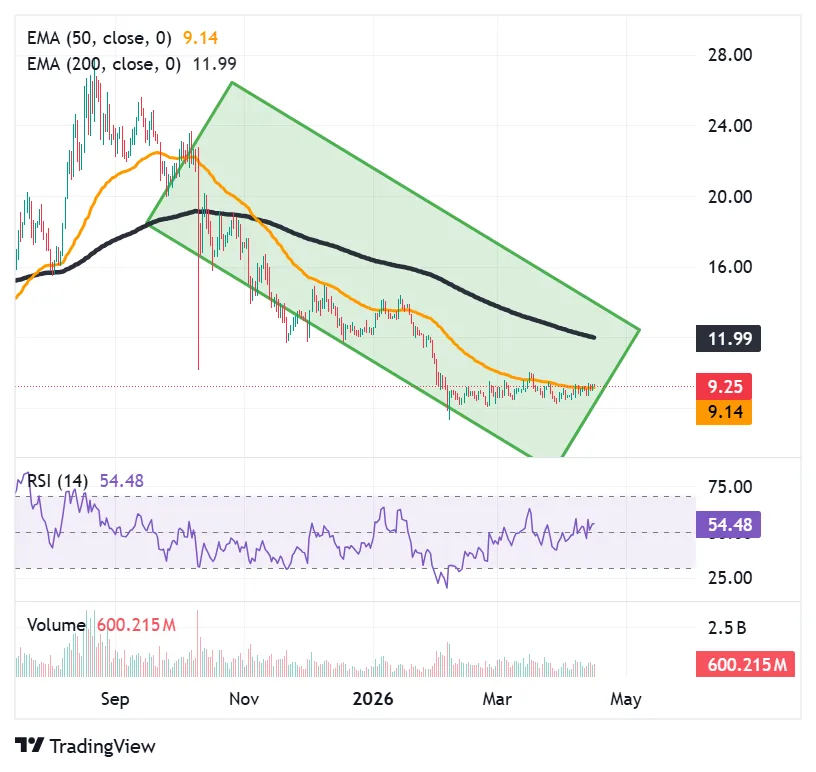
Why? The RSI has been making higher highs and higher lows when the LINK price has been moving quite horizontally. Usually, the RSI and the prices move in unison. However, in this occasion, although the RSI is making higher highs and higher lows, the price is consolidating. This shows there is a bullish divergence or that the building bullish momentum has not been reflected on the LINK price charts. Hence, the price of LINK might shoot upwards in the coming days.
For instance, let’s examine the price changes since February following the massive dip. As shown in the chart below, the broader pattern reveals that LINK is currently fluctuating inside the ascending channel, with higher highs and higher lows.
Chainlink price move inside a complex ascending channel
An ascending channel is a bullish chart pattern where price moves upward within two parallel trendlines: a rising support line below and a rising resistance line above. It shows that the market is in a steady uptrend, but instead of moving in a straight line, price is climbing in a controlled zig-zag pattern
Inside an ascending channel, prices fluctuate between the rising support and the rising resistance levels. It is more or less of a diagonal zigzag motion. When prices reach the level of rising support, they attract buyers to the market, who then purchase at that point and drive prices up. Conversely, when prices hit the new high or the rising resistance, sellers enter.
Traders tend to act differently in accordance with this kind of setup. For example, swing traders typically go long when they find support and short at resistance levels. Breakout traders, on the other hand, look for prices that move out of the lower channel to take up a better continuation trade. A few traders may decide to short the upper channel level in anticipation of rejection.
An ascending channel continues to form as long as buyers keep defending the rising support trendline. However, in the event the price creeps below the lower support line, it can be treated as a potential trend reversal or at least a shift into consolidation.
Meanwhile, if the opposite occurs—a strong breakout above the upper boundary—it could often lead to accelerated bullish momentum, as a breach of the rising resistance signals that buying pressure has overwhelmed the regular cycle of pullbacks.
Smart money continues to accumulate at rising support level
With respect to LINK, the price is compressing against the support line, and it tells us that smart money is quietly absorbing the higher lows and entering the market. Although the accumulation continues to happen between the $8.50 and $9.50 levels, the ascending triangle (purple) shown in the chart is forcing the prices to take a direction rather than move sideways.
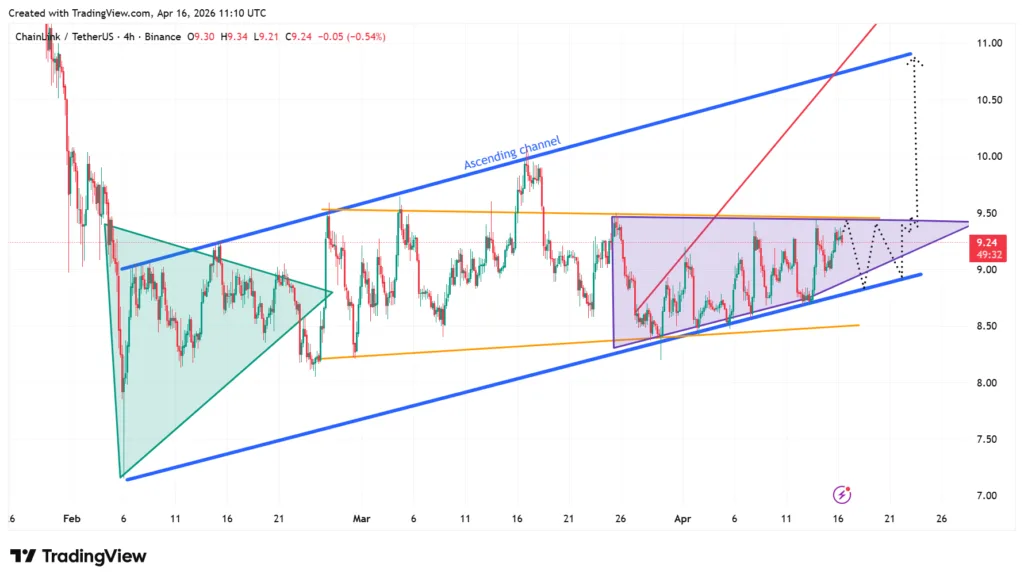
Looking at the structural design, the floor price of LINK has been firmly established at $8.50. The unique aspect of this support level is its history of producing aggressive bounces, and a repeat of this behavior is a possibility.
The upper limit of the price action is currently defined by a multi-month resistance trendline, which is rising toward the 11.00 mark. Currently, the prices are closely adhering to the blue support rail, indicating a final squeeze before a potential vertical expansion.
Think of it like a stretched rubber band being pulled to its absolute limit; once the tension hits the threshold, the price will rally above the mid-range hurdle at 9.50. Once this level is broken, the path to the upper red channel is accessible. The geometry here is incredibly clean, showing a transition from sideways consolidation into a parabolic setup.
Broader pattern suggest LINK is bound to spike
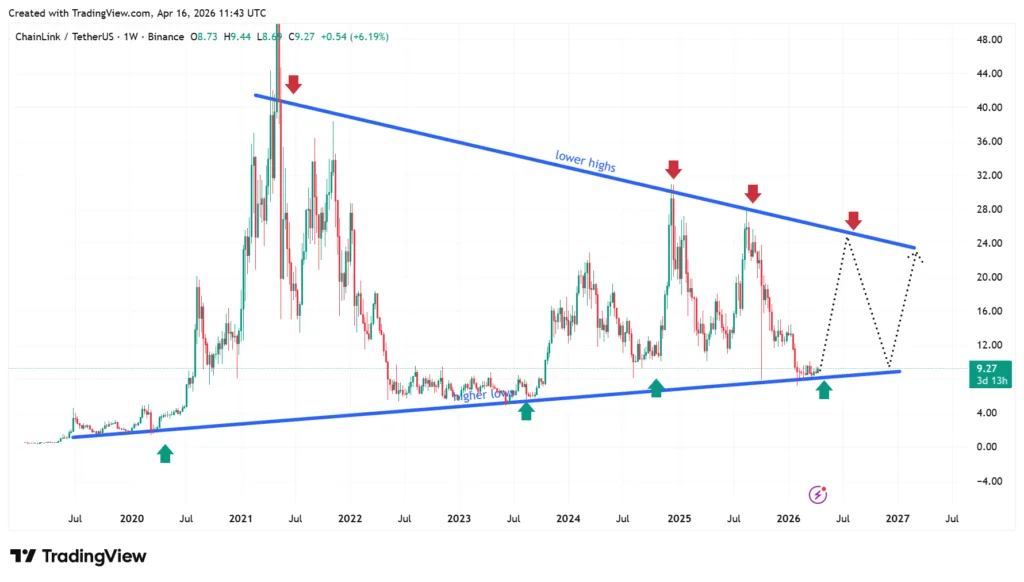
Even when you zoom out and look at the broader structure, the price of Chainlink is still respecting an underlying trend of higher lows, which shows that buyers are not fully losing control. At the same time, the market is compressing into a symmetrical triangle, where price is being squeezed between two converging trendlines—one acting as descending resistance above, and the other acting as rising support below.
How the price behaves inside this pattern is what makes this pattern important. For instance, buyers step in a bit earlier before the price reaches the previous low level. This makes the pattern produce higher lows, reflecting a consistent demand. Recently, LINK bouncing off the lower boundary suggests that buyers are still active and defending key levels, preventing a breakdown in momentum.
On the other hand, the sellers have also been making their contribution by keeping the buyers in check from above as the prices are rejected on each touch of the upper trend line.
Provided that this structure holds, the next natural step for LINK to do is to move towards the upper trendline, as symmetrical triangles often rotate between support and resistance until a decisive breakout occurs. So, this bounce from the lower boundary can be considered another leg in that oscillation—buyers attempting to push price back toward the ceiling of the pattern before the market eventually chooses a direction with a breakout.