

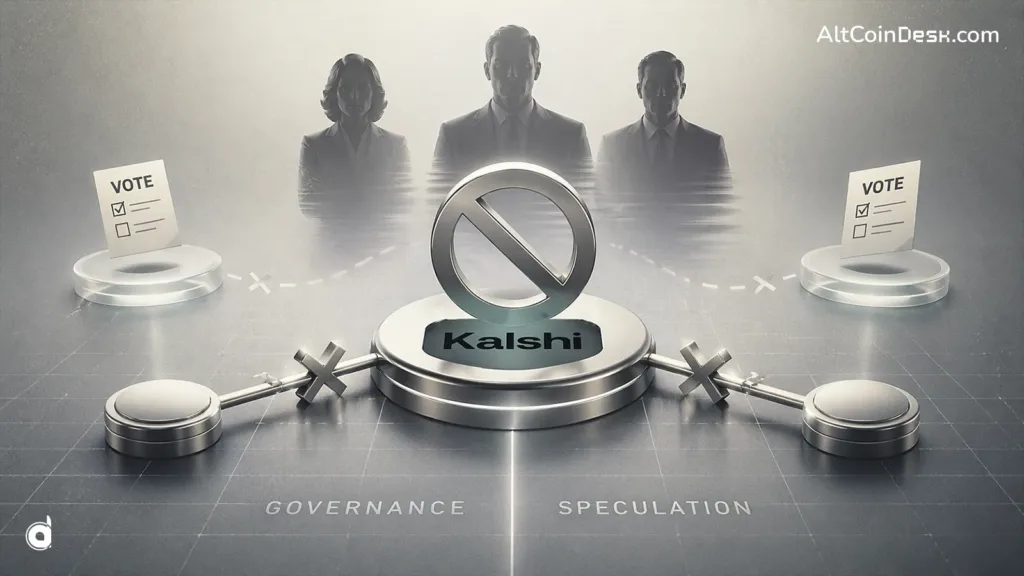

The Prediction market platform Kalshi, banned three congressional candidates from betting on their own elections on the platform. They announced on Wednesday, that they fined and suspended them from their platform for five years.
Inside kalshi’s new regulations: fines and suspensions over political betting
Kalshi said that the three candidates violated new rules. The platform and its competitors have been facing growing scrutiny from lawmakers and regulators over how political betting is policed.
Bobby DeNault, Kalshi’s head of enforcement and legal counsel, said these cases are part of Kalshi’s “proactive engineering solutions” to “identify illicit trading activity.
The platform has introduced a surveillance system that helps with the identity of the users betting on the platform. It flagged a trade involving a Democratic primary candidate in Minnesota’s 2nd Congressional District. They reported that he was seen to trade a small amount on his own election.
“Just like in traditional financial markets, bad actors will try to cheat. Regulated exchanges must constantly evolve and adapt their systems to address insider threats. These three cases are an example of how developing proactive engineering solutions can help identify illicit trading activity,” Kalshi stated in an official press release.
Three cases of politicians betting on their own elections
Matt Klein, the congressman posted a statement on X, that he was only testing out the platform, alongside prediction markets and was unaware of the platform rules.
— Dr. Matt Klein (@DrMattKleinMN) April 22, 2026
This was a mistake and I apologize
Matt Klein
Clarifying over the incident, Kalshi wrote that, “As part of that settlement, he acknowledged that the trading activity violated Kalshi exchange rules, agreed to pay a fine of $539.85, and to a suspension from Kalshi for a period of 5 years.”
The next name on the list was Mark Moran, running as an independent for the U.S. Senate in Virginia. He posted on X to say that he did it on purpose ‘to be caught’ to bring attention to illegal gambling. He said he intended to find out what the Platform would do and how they would react to it.
Finally, one of the moments I’ve been waiting for.
— Mark Moran for U.S. Senate (@itsmarkmoran) April 22, 2026
YES, I did bet ~$100 on myself on Kalshi because I wanted to get caught…
After discovering potential manipulation on polymarket in the NYC mayoral race (NY Post reported on this) I realized how rife with corruption kalshi… https://t.co/9o6wgwTmv8 pic.twitter.com/WJSdHnsfRd
He also used the opportunity to say that firms like Kalshi are ‘destroying’ the country. “We can’t afford homes or healthcare and are subjected to gambling away any money we have bc that’s all that’s left in this country that has been asset stripped by corporations,” he added.
Kalshi alleged Moran stopped responding to all communication with their team and did not comply with their requests to settle the matter. They fined him $6,299.30 and his account is subjected to suspension for five years.
The third case involved a candidate from Texas’s 21st Congressional District, Ezekiel Enriquez. However, Kalshi reported that he was fully cooperative with the investigation and settlement. Acknowledging the rule violation, he paid a $784.20 fine and a five-year account suspension.
These bets follow huge wagers on prediction markets that occurred earlier this year, where an anonymous Polymarket user traded and profited $400,000 on a bet that former Venezuelan President Nicolás Maduro would soon be out of office.