

Bitcoin has continued to dominate the crypto market, with data currently showing the Bitcoin dominance sits at 60%. Despite select altcoins showing recovery signs alongside Bitcoin, the Altcoin Season Index is way below levels that signal significant rotation.
At the same time, the Crypto Fear & Greed Index has spent extended periods in extreme fear. Such a combination reflects a market where capital is defensive and selective. This matters because altcoins depend on excess liquidity to recover.
When risk appetite is low, capital does not spread evenly across the market. Instead, it concentrates on a few high-conviction assets. As a result, a market split occurs, whereby a small group of altcoins hold up or grow, while others continue to drift lower or stagnate.
This article will explore the concept of altcoin season, altcoin recovery 2026, how to identify altcoins set to recover, and the best altcoins to invest in this year.
What is altcoin season in crypto?
Altcoin season, or “altseason,” is the phase where capital rotates out of Bitcoin into higher-risk altcoins. The first major shift usually appears in Ethereum. A rising ETH/BTC ratio signals that investors are taking on more risk. The capital then flows into big-cap altcoins, then mid-caps, and finally small-cap tokens.
Three indicators, declining Bitcoin dominance, increasing volumes of altcoins, and continuing outperformance of altcoins compared to BTC, confirm this process. Traditionally, a decline to a dominance of 45 – 50% is the transition.
During the past cycles, most altcoins were lifted by the rotation from Bitcoin. However, it is not the case in 2026. The number of tokens has expanded massively, and institutional capital is more focused, meaning only select altcoins have the potential to recover. The rotation will probably be experienced across certain sectors like AI, Real-world tokenization (RWA), DePIN, and others, as opposed to the market as a whole.
How to identify altcoins recovery 2026
Some major metrics that you can employ to identify altcoins with recovery potential include the following:
- Fundamental divergence: Identify projects that experience growing on-chain activity, rising Total Value Locked (TVL), and rising transaction volumes, even as token prices decline. This lack of relation between the price performance and ecosystem growth is one of the key indicators of possible survival and recovery in the long term.
- Technical indicators: Pay attention to bullish divergences in weekly charts as altcoins inflate down to lows, but momentum signals like the RSI inflate higher, and bearish momentum drops. In addition, monitor the Altcoin Season Index to determine when 75% of the top 100 altcoins would outshine more than Bitcoin over 90 days.
- Narrative focus: Concentrate on areas where there is institutional interest and narrative preeminence. Some of the key sectors to monitor include AI-powered protocols, Real World Assets (RWA), and DePIN (Decentralized Physical Infrastructure Networks). Assets across these sectors are highlighted to have accumulation potential and strength during rotation from Bitcoin.
- Market structure signals: Monitor the Fear and Greed Index to identify when it reaches extreme fear stages. This typically comes before accumulation opportunities. Also monitor the trends in stablecoin issuance as a forerunner to greater on-chain activity. Inflows into regulated altcoins ETFs, as well as the enactment of clarity acts like the CLARITY Act, are also important catalysts to long-term recovery.
5 best altcoins to invest in 2026
According to the above-mentioned criteria, there are a few altcoins that can potentially be left in 2026:
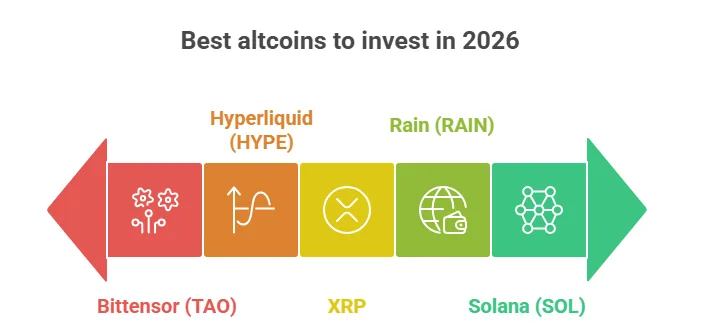
1. XRP
The thesis of the recovery of XRP is based on regulatory transparency. Its dual US regulator recognition has eliminated the biggest obstacle that used to restrict institutional participation. This makes XRP one of the limited number of altcoins with an easy route to ETF-driven demand. In conjunction with a steady level of trading volume and relatively equal positioning in derivatives, XRP presents a more structurally solid arrangement than the majority of altcoins. It is less hype-driven and more in line with controlled capital movements, so it is a good candidate for long-term recovery.
2. Solana (SOL)
Solana continues to be among the most fundamentally strong Layer 1 networks. Its advantage is that it is used in real-world applications, especially micro-transactions with stablecoins and high-frequency applications. The upgrades,s such as Firedancer and an increase in consensus efficiency, are still dealing with previous reliable issues. Although the ecosystem trades at lower levels than before, the growth of the ecosystem, the level of developer activity, and institutional inflows indicate continued accumulation. The scalability and low costs of Solana continue to keep ita long-termn infrastructure play that is long-term.
3. Bittensor (TAO)
Bittensor is one of the most powerful AI-intensive crypto narratives. Its decentralized machine learning network has proven to have real practical use in the large-scale training runs, and shows that distributed AI development can rival centralized models.
There is an increasing institutional interest, and the prospect of regulated investment products is providing an added benefit. It, however, has a high rate of price boost, which brings about volatility risks, and timing is therefore key. With AI still taking over capital allocation, Bittensor is at the heart of that trend.
4. Hyperliquid (HYPE)
Hyperliquid is unique in its token mode,l being revenue-based. The platform revenue is also spent on buying back tokens, which generates a recurring demand regardless of any specification flows. Its access to real-world asset perpetual markets has already yielded enormous trading volumes, particularly when there is a Macro storm.
Although there are risks, especially when leveraged positions are involved, and when it comes to issuing tokens, the fact that this project creates real cash flow provides it with a structural advantage over mostly speculative assets.
5. Rain (RAIN)
Rain offers a special crypto exposure and on-the-ground infrastructure to payments. It has billions of dollars worth of transactions and partnerships with other world payment systems, and this makes it more useful than other blockchain projects.
The system of its token economy has usage-based governance and deflationary incentives depending on the expansion of the network. However, a risk factor is still the token schedule unlock schedules. Nonetheless, the adoption of Rain into the world payment systems makes it one of the few altcoins that have a physical presence in the real world.
Conclusion
The structure of the altcoin market has changed. The expansion in token supply and the concentration of institutional capital mean that recovery will not be broad. Most altcoins will not return to previous highs in the incoming altcoin season due to the lack of sustained demand.
However, investors can identify survivors by focusing on fundamentals, technical indicators, narrative focus, and market structure signals. Projects with real usage, clear narratives, and institutional alignment have a higher probability of recovery.