



Crypto regulations 2026 indicate a clear move towards enforcement, oversight, and organized control in the global markets. As a result, exchanges, stablecoins, and on-chain activity come under greater control by regulators, with emphasis on anti-money laundering, compliance with sanctions, and investor protection.
In the U.S, bills like the Digital Asset Market Structure Bill are moving forward to introduce more explicit regulations on the classification and regulation of digital assets and the crypto market. Meanwhile, the GENIUS Act is also imposing harsh conditions on stablecoin issuers, such as reserve disclosures and transaction control. These crypto regulations 2026 are minimizing the gray areas, as well as raising compliance requirements of both platforms and issuers.
In Europe and Asia, frameworks such as the Markets in Crypto-Assets Regulation and new stablecoin licensing regimes are solidifying the same trend. Regulators are harmonizing regulations, enhancing monitoring, and reviewing the cross-border flows and decentralized systems.
Key crypto regulations 2026
The following are some of the key crypto regulatory developments this year:
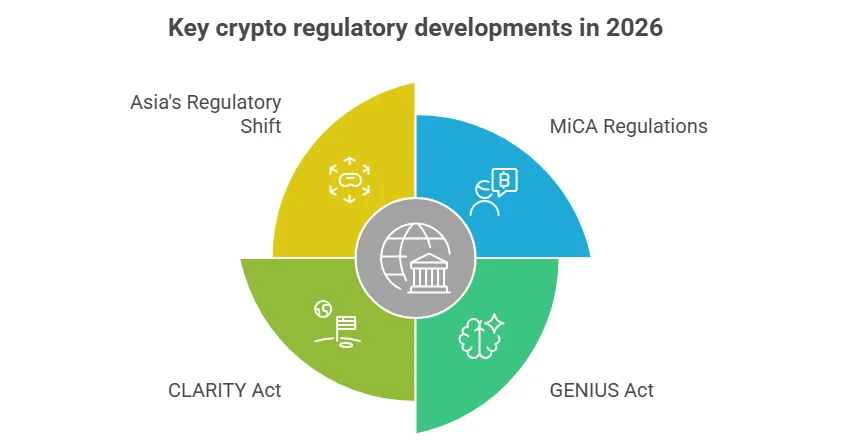
1. MiCA regulations
The Markets in Crypto-Assets Regulation (MiCa) is one of the most comprehensive crypto-regulations currently in effect. This regulation’s emphasis now is on enforcement as opposed to rollout by 2026. Crypto-asset service providers will have to satisfy stringent requirements across licensing, governance, custody, disclosures, and operational resilience.
Under the new MiCA crypto framework, companies that do not receive permission will not be able to operate in the EU. This implementation has already resulted in fines and delistings, particularly in the stablecoin market, where there are tough reserve and transparency requirements. The outcome is a reduced yet more plausible market in which compliance wins the day.
For investors, MiCA will eliminate uncertainty across the crypto market. The EU has the consistency of rules in all its states, and the legitimacy of a platform is more readily verified. The cost involves less asset variety since non-facilitating tokens and services will not be sorted or entered into the regulated network.
2. GENIUS Act
The GENIUS Act introduces stablecoins to a more formal regulatory framework, in line with standard finance. Issuers have to uphold a full reserve support, make periodic disclosures, and uphold high-quality AML and sanctions compliance criteria.
One of the specifications is transaction control. Issuers need to have the capabilities to block or freeze flagged activity transactions. This will create an element of regulation previously unavailable in the previous crypto markets and bring stablecoins nearer to regulated financial products.
The GENIUS Act framework reduces systemic risk and facilitates institutional usage. It also transforms the practical functioning of stablecoins. It also boosts trust and reduces neutrality as the need to comply determines the manner in which transactions are made and monitored.
3. US market structure bill (CLARITY Act)
The Digital Asset Market Structure Bill solves the digital asset classification. This has been one of the most problematic issues in the US crypto market. Establishing how tokens are classified as securities or commodities determines the manner in which these tokens are governed and by which authority.
Currently, the present fragmentation provides a patchy rule of exchange between issuers and investors. The suggested framework will help set the boundaries more clearly, define responsibilities, and make the approach to digital assets treatment standardized across the market.
The CLARITY Act reduces risks by minimizing flexibility in how tokens are classified. Digital assets that previously functioned in grey areas will have to fit into definite regulatory groups, potentially transforming the design of tokens, issuance structures, and exchange listings.
4. Asia’s regulatory shift
Asia is also speeding up regulatory development due to competition and control in 2026. Most Asian countries are putting crypto licensing at the forefront of crypto regulations with stricter controls.
Regulators in Hong Kong, for instance, have granted the first stablecoin licenses with strict reserve requirements. This makes the country a regulated space for the settlement of digital assets and cross-border finance.
South Korea is also developing laws that impose high reserve requirements and a single regulation for crypto exchanges, stablecoin issuers, and custodians. The strategy focuses on financial security and protection of investors, even at the cost of smaller players in the market.
On the other hand, Japan has made a structural move to place crypto under the Financial Instruments Law. This brings on insider trading regulations, compulsory disclosures, and more severe punishment, bringing crypto a bit closer to the conventional capital markets.
Regulatory trends shaping investor outcomes in 2026
The following are some key crypto regulations trends in 2026:
- Licensing as a due diligence check: With maturity in the licensing systems, the authorization status has become a fundamental filter for investors. In Australia, for instance, there are joint requirements for the registration of organizations through the Australian Securities and Investment Commission (AUSTRAC). This increases the level of compliance and establishes greater credibility.
- Sandboxes boost stablecoin and tokenization pilots: Regulatory sandboxes are a common method to test stablecoins, tokenized deposits, and similar products. This is broadening the scope of possible investments and creating new thinking on the redemption conditions, backup of reserves, and connecting it to the conventional financial systems.
- International crypto enforcement: The global community is becoming increasingly unified in crypto regulation, and some of these organizations actively participate in this task, including the Financial Action Task Force. The trend of collaboration across borders is increasingly gaining momentum, and evading compliance in a different jurisdiction and shifting the business to another one is a challenge that is on the rise.
- Asset recovery and fraud tracking: Increased compliance measures, aided by better exchange controls and more sophisticated blockchain analysis tools, are improving how fraud is dealt with. Although there are still risks, governments are better positioned to track illegal flows and organize the actions aimed at recovery across borders. There are also more cooperative exchanges on enforcement requests.
- Specific enforcement of sanctions: The regulators are moving towards a more data-driven approach to imposing sanctions in crypto markets. Further analytics enable it to discover the exposure to restricted addresses, including indirect transactions. This enhances the risk of having frozen accounts or blocked withdrawals when user activity is flagged.
Conclusion
Crypto regulations 2026 are shifting from disjointed regulation to organized regulatory frameworks. MiCA regulation defines the European model, the GENIUS Act crypto framework reshapes stablecoin oversight, and the CLARITY Act aims to resolve classification challenges in the US.
Asia is advancing in parallel, combining strict licensing with aggressive stablecoin development. Across all regions, the direction is consistent: crypto is being integrated into the financial system under enforceable rules.
For investors and businesses, compliance is no longer optional. It determines access, liquidity, and long-term viability. The market is becoming more stable and more predictable, but also more controlled. Understanding regulation is now as important as understanding the assets themselves.