

Right, so let us get something out of the way before we dive in. This is not another breathless explainer about how blockchain is going to change everything while conveniently forgetting to mention when, how, or why anyone should care. No.
What is happening with Hong Kong web3 adoption right now is something far more interesting than a conference press release dressed up as a revolution. It is a government, with suits and stamps and a very serious central bank, quietly wiring blockchain technology into the plumbing of one of the world’s oldest financial centers. And it is doing it faster than most people noticed.
So pull up a chair. This one is worth your time.
The man, the mic, and the $2 billion number
On April 20, 2026, Financial Secretary Paul Chan took the stage at the Hong Kong Web3 Festival and said, in so many words, that the city is done dabbling. He described Web3, tokenization, and artificial intelligence as the essential building blocks of what mainstream finance is becoming, not what it might become in some hopeful future but what it is turning into right now. He told every Web3 entrepreneur and institution within earshot that the city’s doors are wide open.
Now, finance ministers saying nice things at tech conferences is hardly headline news. Every city, from Lisbon to Dubai, has someone in a nice blazer telling founders their ecosystem is world-class. What separates Chan’s speech from the usual noise is the receipts he brought with him.
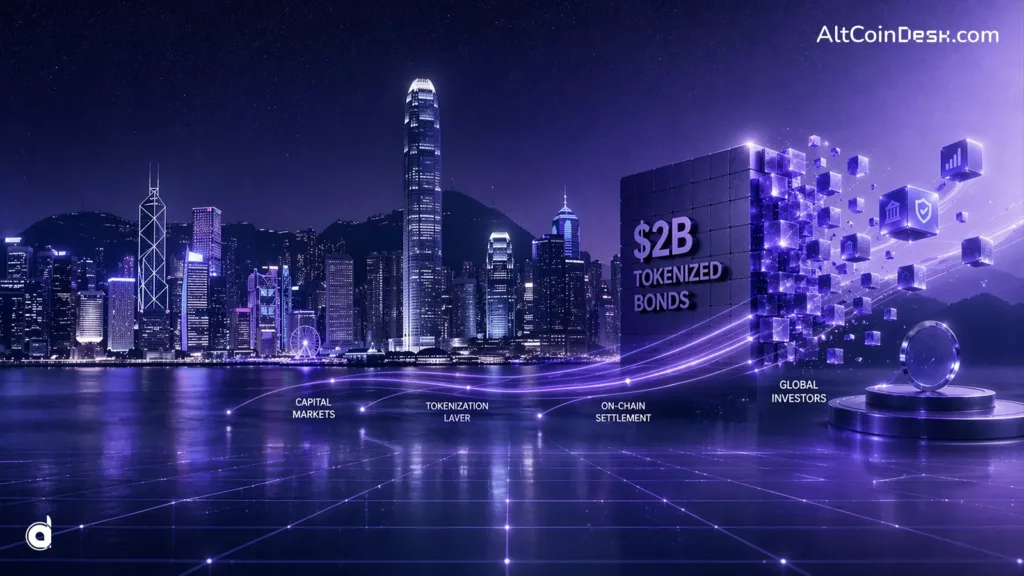
Hong Kong has issued multiple rounds of tokenized green and infrastructure bonds totalling well over US$2 billion. That is not a pilot. That is not a sandbox. That is a government repeatedly going to market with blockchain-based debt instruments, getting investors to buy them, and then doing it again.
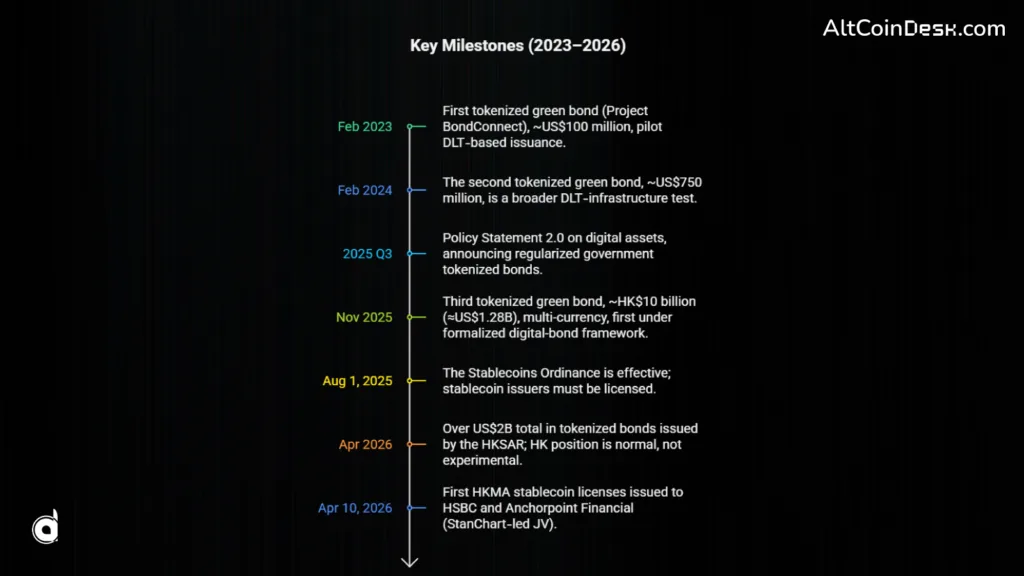
The third batch alone, issued in late 2025, clocked in at around HK$10 billion, issued across Hong Kong dollar, renminbi, US dollar, and euro tranches; certified green; rated at the sovereign level; and settled using tokenized money.
If you were waiting for institutional legitimacy to show up in the tokenization conversation, you may have missed it walking through the door.
When your banker becomes your blockchain issuer
Here is where the story gets genuinely strange and wonderful in equal measure.
On April 10, 2026, the Hong Kong Monetary Authority (HKMA) issued the city’s very first stablecoin licenses under the Stablecoins Ordinance, which came into effect on August 1, 2025. The winners, chosen from 36 formal applications, were not some scrappy crypto startup operating out of a co-working space with an inspiring whitepaper and a Discord server with 40,000 members. They were HSBC and Anchorpoint Financial, a joint venture formed by Standard Chartered, Hong Kong Telecommunications, and Animoca Brands.
Let that sink in for a moment. The bank that has been printing Hong Kong dollar banknotes for over a century is now licensed to issue a digital version of that same currency on a blockchain. HSBC plans to launch a Hong Kong dollar stablecoin, fully backed by high-quality liquid assets, in the second half of 2026. It will work through the HSBC mobile banking app and PayMe, which most Hongkongers already use to split restaurant bills and pay rent. Peer-to-peer. Peer-to-merchant. Tokenized investments.
Meanwhile, Anchorpoint brings together traditional finance credibility from Standard Chartered, the telecom infrastructure of HKT, and the Web3 native instincts of Animoca Brands. It is an unusual combination that looks a lot like someone deliberately assembling a team capable of bridging the gap between a Bloomberg terminal and a crypto wallet.
HKMA Chief Executive Eddie Yue described the licenses as an important milestone in developing a healthy, responsible, and sustainable stablecoin ecosystem. The HKMA’s deputy noted the two recipients were specifically chosen for their depth of experience in traditional finance and risk management. That is the regulator sending a very clear signal: this is not a free-for-all.
The rules are the product
One of the more underappreciated parts of Hong Kong’s strategy is just how deliberately boring its regulatory philosophy is, in the best possible way.
The city has anchored its digital asset approach around a principle that sounds almost aggressively obvious: the same activity, the same risk, and therefore the same regulation, whether it happens on a blockchain or not. This sounds like a platitude until you realize how many jurisdictions have spent years trying to figure out whether crypto fits into existing rules or requires entirely new ones, tying themselves into legal knots in the process.
Hong Kong simply said, “If it looks like a bond, regulate it like a bond.” If it looks like a payment instrument, regulate it like one. The result is that global banks, asset managers, and market makers can reuse their existing compliance, know-your-customer, and governance frameworks for tokenized products. No reinventing the wheel. No hiring a separate team of blockchain lawyers to interpret three contradictory guidance documents.
The stablecoin licenses reflect the same philosophy. Licensed stablecoin issuers must hold a minimum paid-up share capital of HK$25 million, maintain HK$3 million in liquid capital, and keep a twelve-month buffer of operating expenses. Only fully reserved, high-quality asset-backed stablecoins can reach retail investors. Transfers above HK$8,000 trigger the travel rule. Smart contracts will embed compliance checks, restricting transfers to verified wallets.
This makes Hong Kong’s HKD stablecoins structurally very different from the freely transferable tokens most of crypto Twitter argues about. That is a feature, not a bug, at least if your goal is wiring digital assets into legitimate financial infrastructure rather than building a censorship-resistant parallel economy.
AI enters the chat, literally
Chan did not stop at tokenization. He explicitly described 2026 as a turning point driven by the convergence of Web3 and artificial intelligence, particularly the rise of agentic AI systems that can analyse information, make decisions, and carry out actions autonomously, including interacting directly with other blockchain-based systems.
The vision he sketched is one where AI agents operate at machine speed, executing financial transactions, managing liquidity, and navigating supply chains using blockchain infrastructure running quietly in the background. To advance this, Hong Kong announced plans to form an AI Plus and Industry Development Strategy Committee dedicated to promoting integrated Web3 and AI use cases across finance, trade, and logistics.
This is not a fringe idea being floated by a well-meaning policy intern. It is the Financial Secretary of one of the world’s most important financial centers telling the market where it is putting its regulatory and institutional energy for the next several years.
Why this is not Singapore, and why that matters
Look, Singapore is excellent. Dubai is impressive. Both have invested seriously in digital asset frameworks, and neither is asleep at the wheel. But let us be precise about the differences, because they are meaningful.
Singapore has strong institutional tokenization programs and a well-developed fintech sandbox ecosystem under Project Guardian. Dubai has VARA, a regulator willing to move fast and grant licenses to a wide variety of crypto businesses, backed by the appeal of low taxes and high ambition. Both are legitimate hubs with genuine momentum.
What Hong Kong has done differently is stack sovereign tokenized bonds, bank-grade stablecoin licenses, regulated crypto exchange-traded funds, and a clear regulatory principle under one roof, and done all of it at scale rather than in controlled experiments. More than US$2 billion in government-issued tokenized bonds is not a proof of concept anymore. It is a track record.
Hong Kong is also uniquely positioned as the financial gateway between mainland China, which runs one of the world’s most tightly controlled capital systems, and global markets hungry for exposure to Chinese assets. Tokenized bonds and regulated stablecoins, issued under Hong Kong law but accessible to international investors, create a corridor that neither Singapore nor Dubai can replicate. That geography is not accidental. It is the whole point.
So what does this mean for you, specifically?
If you are building in Web3, Hong Kong has explicitly told you the lights are on. The government wants entrepreneurs. It wants institutions. It wants people building settlement infrastructure, cross-border payment rails, and tokenized real-world assets. The regulatory framework is clear enough to work with and flexible enough not to crush innovation before it starts.
If you are an investor, the fact that HSBC is now a licensed stablecoin issuer should tell you something about where institutional capital is placing its longer-term bets on digital finance. Tokenized bonds that settle faster, cost less to issue, and reach a broader investor base are not a crypto story. They are a fixed-income story with a technology upgrade attached.
If you are a skeptic, and there is nothing wrong with being a skeptic, the honest answer is that what Hong Kong is building right now looks less like a crypto casino and more like an upgrade to the financial operating system. Whether that upgrade delivers on its promises over the next five years is a genuinely open question. But the ambition, the regulatory architecture, and the institutional participation are all considerably more serious than most of the Web3 adoption narrative deserves credit for.
The opening move, not the headline
Paul Chan said the stablecoin licenses are not meant to be the big moment. They are the opening move in a longer push. That framing is worth taking seriously. Hong Kong did not issue two licenses from 36 applications because it ran out of paperwork. It issued two because it wanted to start with the institutions it trusted most, set a standard, and build from there.
The next rounds of tokenized bonds will come. More stablecoin licenses will follow as the register grows. Project Ensemble, the HKMA’s experiment in tokenized money market fund transactions using tokenized deposits in near real time, continues to run. The AI Plus committee will eventually produce something that looks less like a committee and more like policy.