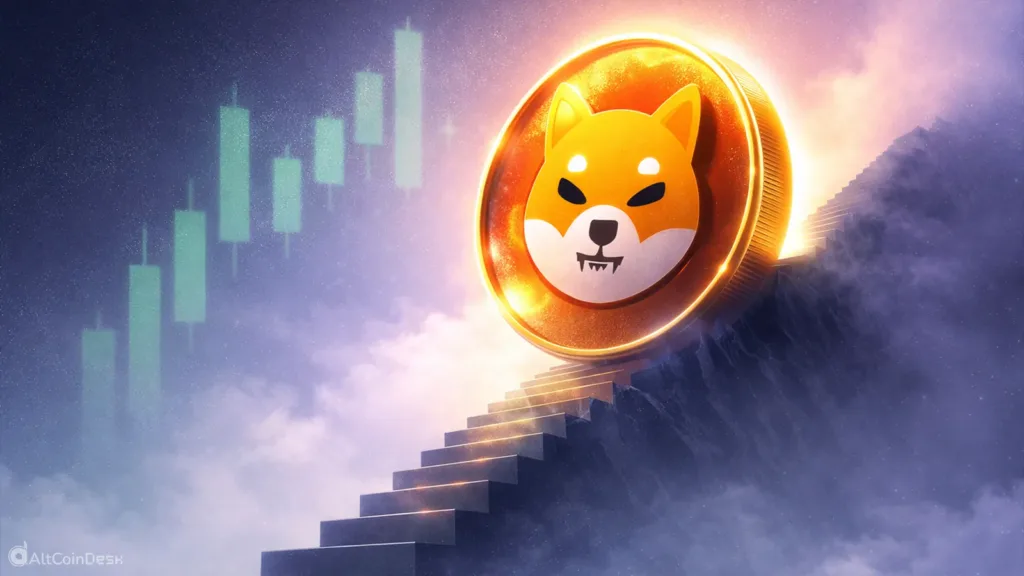

The famous poster pup of memecoins, Shiba Inu’s story, is one of a kind. What began as a memecoin mocking another memecoin, Dogecoin, took the crypto market by storm, turning into a multi-billion dollar digital currency in a matter of months.
Today, Shiba Inu has a thriving ecosystem, a dedicated layer-2 blockchain called Shibarium. In addition, it has a strong online community, with the number of token holders ranging in the millions.
In spite of all these favorable metrics, one question that continues to linger in the minds of SHIB holders is whether SHIB can ever realistically reach $1. Let us look at the math behind the memecoin’s tokenomics and evaluate whether it’s actually possible or a distant pipedream.
Understanding Shiba Inu’s enormous supply
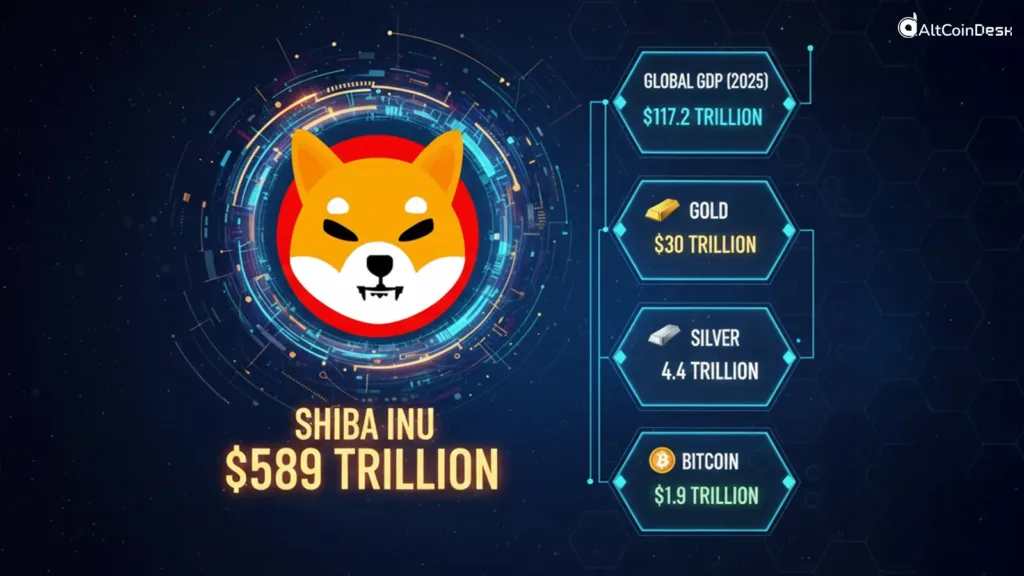
The biggest obstacle standing between SHIB’s price and the highly anticipated $1 target is the token’s comically large supply. According to Coingecko, SHIB token’s total supply is 589 trillion. The digital asset currently has a total market cap of $5.45 billion, ranked 34th on the list in terms of total market cap.
It should be noted that the 589 trillion supply is after a significant amount of SHIB tokens have already been burned as part of buybacks, regular token burns, and other methods in an attempt to inflate the token’s price. Shiba Inu initially had a total token supply of 1 quadrillion, a figure that most people would find difficult to comprehend.
SHIB’s token supply matters because it directly impacts its total market cap. A coin or token with a small supply, such as Bitcoin, will typically have a high price per unit. On the contrary, a token like SHIB with a large supply will have a per-unit price in fractions of cents.
If SHIB ever reaches a $1 price, that would essentially mean a total market cap of $589 trillion. For comparison, according to the World Bank, the total global GDP in 2025 stood at roughly $117 trillion. So, a $1 SHIB token would hold a market cap that is more than five times the total global GDP.
Can more SHIB token burns change the equation?
One argument that frequently makes it to the surface is whether frequent and larger token burns help SHIB’s price rise to $1. Theoretically, this should be possible, as a lower supply would effectively remove excess tokens from the market, moving the supply curve to the left and intersecting with the demand curve at a higher price.
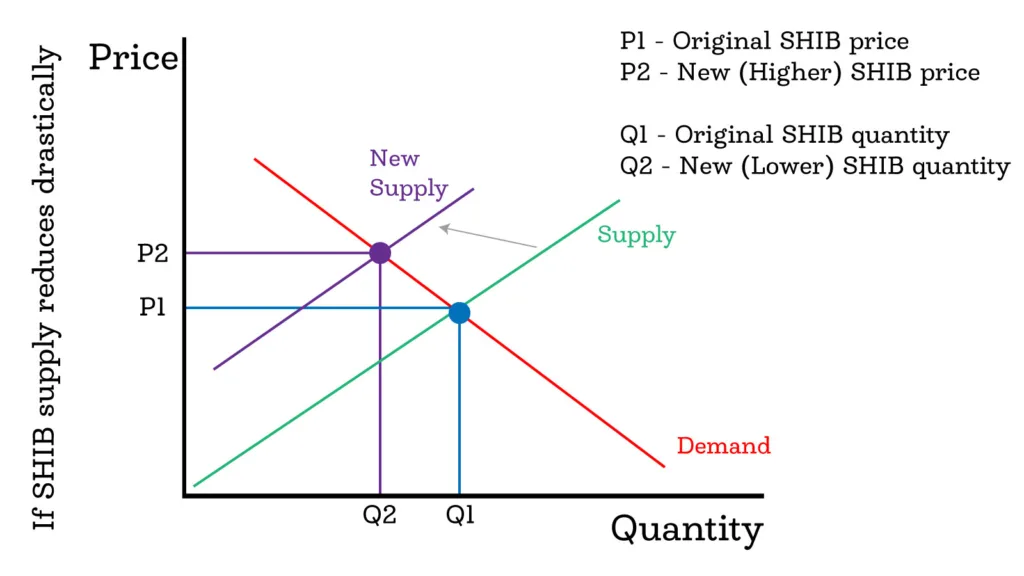
However, reality is far different from theory. In Shiba Inu’s case, burning millions or even billions of SHIB tokens daily would hardly move the needle. Assuming Shiba Inu developers burn 1 billion tokens every day of the year, it would only reduce the total token supply by 365 billion.
By removing 365 billion tokens from a total supply of 589 trillion, the net reduction in percentage terms would be less than 1%. For SHIB to ever have a realistic chance of reaching $1, more than 99% of the supply will have to be removed from circulation, which would require decades’ worth of time if token burns continue at the current pace.
Will SHIB’s utility and ecosystem growth help?
Another factor worth considering is Shiba Inu’s constantly evolving ecosystem. Since its launch, SHIB has grown beyond just a memecoin to a whole ecosystem, which has its own layer-2 blockchain, a decentralized application store, multiple token utilities, non-fungible tokens (NFTs), and a lot more.
The aforementioned offerings are intended toward increasing SHIB’s utility and, in turn, demand. A rising demand for SHIB will move the demand curve to the right, which will put pressure on the price and lead it upwards.
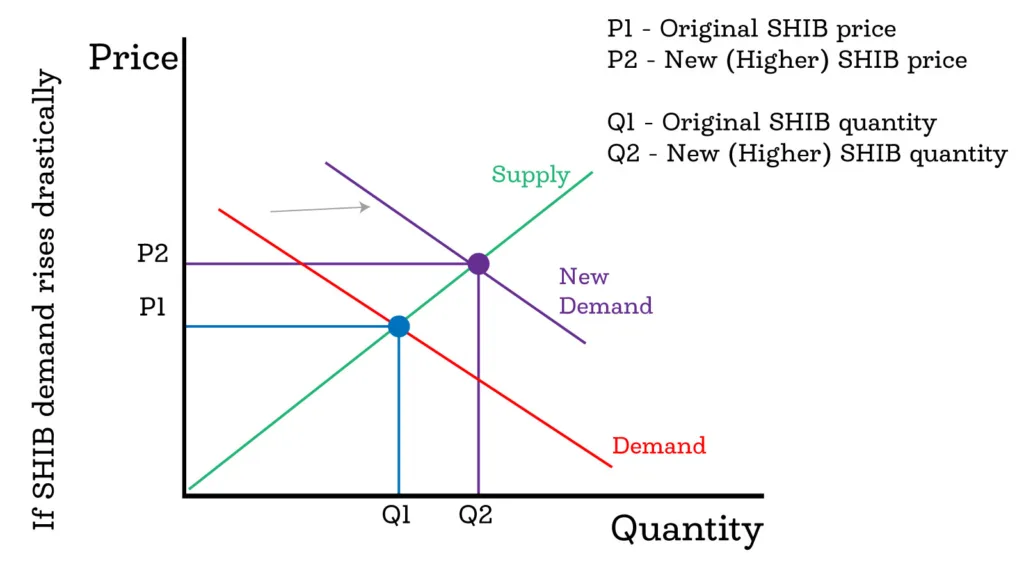
If SHIB’s demand rises significantly, adding billions of dollars to its market cap, it will have minimal impact on the token’s price when compared to the $1 target. In a very optimistic scenario, if SHIB’s total market cap reaches that of Bitcoin, around $1.8 trillion, it would only result in a per-token price of $0.000003054.
Can major institutional interest in SHIB propel it to $1?
Yet another potential source of major demand for SHIB could be rising institutional interest in the token. As the crypto industry has seen, the approval of the first spot Bitcoin exchange-traded fund (ETF) in the US opened the floodgates of capital into the digital asset, leading to billions of dollars being sucked into the financial product, having a positive effect on BTC’s price.
We observed a similar trend with Ethereum (ETH), Solana (SOL), and XRP. All of these digital assets have multiple, regulated ETFs in the US today and regularly attract funds from institutional investors seeking exposure to digital assets without necessarily the risk of physically holding them in a wallet that can be attacked by nefarious elements.
If SHIB experiences similar interest from hedge funds, financial institutions, and corporate treasuries, then it can certainly benefit. However, to think that the benefit would be of such a high magnitude that it would catapult SHIB to $1 would be a little too far-fetched.
Further, there are certain liquidity challenges that come with SHIB’s ridiculously high token supply. If institutions buy trillions of SHIB tokens daily, it could pressure exchanges, especially the ones with thin order books.
Realistic price numbers for SHIB
So, if not $1, what’s a realistic price target for SHIB? Let’s look at the tokenomics. While $1 might be out of reach in practical terms, it doesn’t mean that the token has no upside potential. An appreciation in price to $0.0001 or $0.001 would still mean strong gains for the memecoin.
If SHIB reaches a price of $0.0001, then the token’s total market cap would surge to around $58.9 billion. While still huge, such a market cap is not outside the realm of reality. If SHIB reached a market cap of $58.9 billion, it would place the token on the 8th position in terms of total market cap, placed between USDC and Lido Staked Ether.
If SHIB reaches a price of $0.001, the token’s market cap would skyrocket to $589 billion. Such a huge market cap would firmly place the token in the second position, eclipsing Ethereum, which currently holds a market cap of $388 billion. In such a scenario, it would only be trailing Bitcoin, which currently holds a total market cap of $1.8 trillion.
Final verdict – hype vs hard numbers
In conclusion, SHIB cannot reach a value of $1. At least, not until there is a radical change in the project’s tokenomics, which may upset existing token holders. The math simply doesn’t support a scenario where SHIB hits $1.
However, this shouldn’t dampen SHIB holders’ ambitions regarding their holdings. The average wallet size of SHIB holders is around $18,000, although this figure is inflated by whale wallets to a large extent.
Still, if the SHIB market cap grows in size by ten times from its current $5.4 billion, it would increase the average wallet holdings to $180,000, while a 100-times increase would skyrocket it to $1.8 million. While not $1, these figures would still offer attractive returns to holders.