


Crypto has a funny way of making people feel like they’re either five years too late or one day away from missing the opportunity of a lifetime. Neither is true, and neither feeling should be driving a financial decision. Figuring out how much to invest in crypto in 2026 doesn’t require a massive portfolio or a background in finance. It requires a clear plan, honest expectations, and a genuine understanding of how much you can afford to put at risk.
Before any numbers, the mindset has to come first. Crypto isn’t a savings account, and it doesn’t come with guaranteed returns. The only rule worth carrying into this space is never to invest more than you can afford to lose entirely, because even the strongest assets here have dropped 40% to 50% in a matter of months and barely made headlines.
The real starting point for crypto investment for beginners
Most beginners assume the first question is which coin to buy, but it’s actually how much of their total savings and investments crypto should represent at all, because getting that wrong is what turns a learning experience into a genuinely stressful one.
The 1% to 5% rule that keeps things reasonable
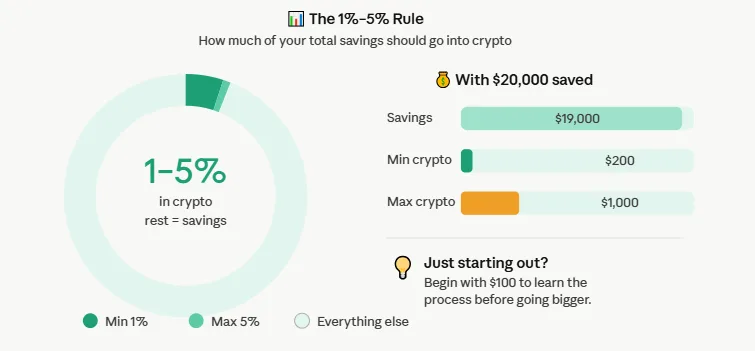
Financial advisors tend to suggest keeping crypto between 1% and 5% of a total investment portfolio. So if someone has $20,000 in savings and investments combined, putting somewhere between $200 and $1,000 into crypto is a reasonable range to work within. For someone just starting out with no other investments yet, beginning with $100 purely to get familiar with how everything works is a genuinely smart first step, not a limitation.
How much money to start crypto depends on where you’re starting from
Knowing how much money to start crypto with changes the entire approach, and trying to follow a strategy built for $5,000 when starting with $200 leads to avoidable mistakes.
A straightforward breakdown by budget
Under $100 is education money. Buy a small amount of Bitcoin or Ethereum just to understand how wallets and exchanges work and what it feels like to actually own crypto. Platforms like Coinbase and Kraken let you start with as little as $10, so the barrier to entry at this level is basically nonexistent.
Between $100 and $500, the move is to stick to one or two coins and keep it clean. Bitcoin or Ethereum only. Spreading across multiple coins too early dilutes gains and multiplies confusion without adding any real upside.
Between $500 and $1,000, there’s enough to build a small but intentional portfolio. A solid starting point is roughly 70% in Bitcoin or Ethereum as the foundation, and up to 30% in one or two other coins that have been properly researched, not just ones someone mentioned in a group chat the night before.
Between $1,000 and $5,000, exploring specific market narratives like AI tokens or privacy coins starts to make sense, but the core should still sit heavily in Bitcoin and Ethereum. The speculative allocation comes on top of the foundation, never instead of it.
At $5,000 and above, spreading entries over three to six months rather than going in all at once becomes the smarter play. It’s also worth considering whether a Bitcoin ETF through a regular brokerage account handles part of the allocation more cleanly, especially for anyone who’d rather not manage wallets and exchanges directly.
How to split $1,000? 3 approaches for 3 different mindsets
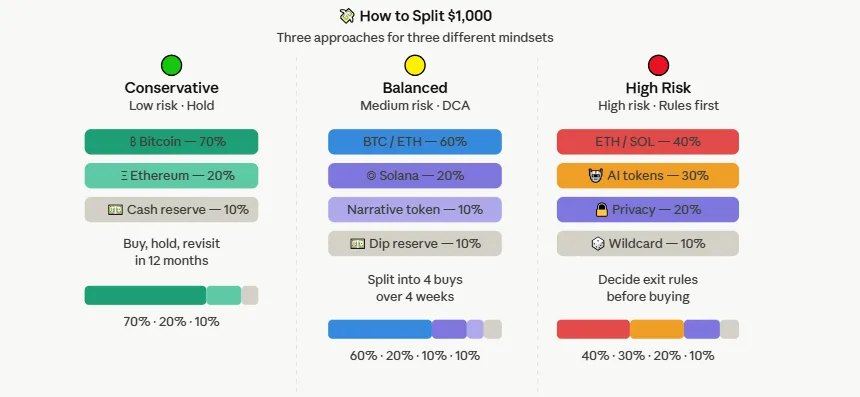
$1000 is a realistic starting point for someone ready to move beyond experimenting and actually build a position. The way that money gets split matters more than the specific coins chosen, because the split reflects risk tolerance, and getting that alignment right is what keeps someone in the game when things get volatile.
The conservative split
For someone who wants exposure without losing sleep over it, a reasonable approach is 70% into Bitcoin, 20% into Ethereum, and 10% kept as cash to buy more if prices drop. That reserved cash isn’t indecision, it’s called dry powder, and it’s one of the most underrated moves a beginner can make.
The strategy is to buy, hold, and check back in 12 months rather than watching charts every day.
The balanced split
For someone with a bit more knowledge and appetite for growth, a workable split is 60% into Bitcoin or Ethereum as the core, 20% into Solana, which runs faster and cheaper than Ethereum and trades at a significantly lower market cap, 10% into a speculative token tied to a current market narrative, and 10% held back for dips.
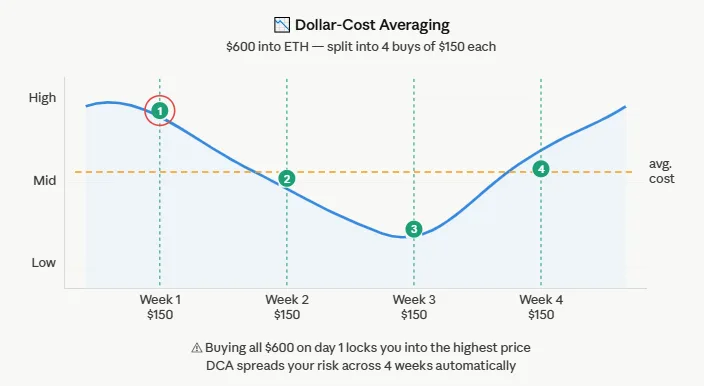
The strategy here is dollar-cost averaging, which means splitting the $1,000 into four equal buys over four weeks instead of going all in on day one.
The high-risk split
For someone who has specifically set aside money they’re prepared to lose entirely, a possible breakdown is 40% in Ethereum or Solana as a base, 30% in AI-focused tokens, 20% in privacy coins, and 10% in something early stage that could either multiply or go to zero.
The non-negotiable part of this approach is setting rules before buying anything. If a position drops 50%, the decision to hold or cut should already be written down, not made in the moment when the charts are moving fast and emotions are louder than logic.
Two narratives worth paying attention to in 2026
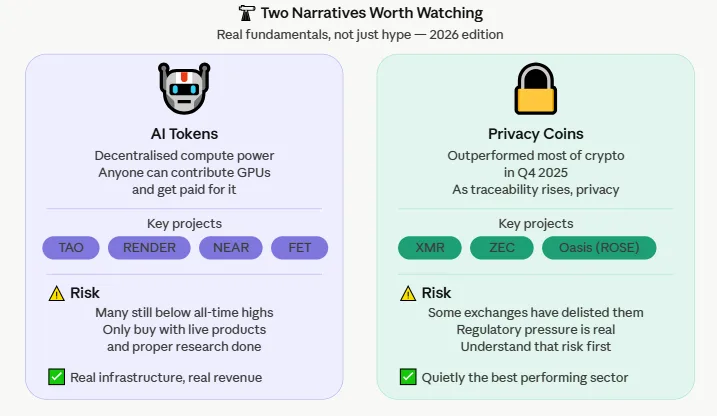
Going beyond Bitcoin and Ethereum means knowing where the real fundamentals are, not just following the hype, and right now, two areas stand out.
AI tokens
Decentralized AI networks let anyone contribute computing power and get paid for it, instead of one company owning the entire infrastructure.
Projects like Bittensor, Render Network, and NEAR Protocol are among the more established names here, all with real products already running rather than just whitepapers and big promises. The risk is that many tokens in this sector are still well below their all-time highs, so doing the research before buying is what separates a calculated bet from a blind one.
Privacy coins
Privacy coins outperformed most of the crypto market in the final quarter of last year, and the logic behind them is straightforward. As blockchain transactions become easier to trace, financial privacy becomes more valuable.
Monero and Zcash are the most established names in this space, though it’s worth knowing upfront that some exchanges have delisted privacy coins due to regulatory pressure, which is a real risk that needs to be factored in before putting money there.
The risk that has nothing to do with the market
Bad projects and scams get most of the attention when it comes to crypto risk, and they’re worth taking seriously. But there’s a quieter risk that consistently does more damage than either of those, and it’s entirely within a person’s control to manage before a single dollar goes in.
The pattern plays out constantly. Someone buys in during a period of excitement, the price drops, panic sets in, they sell at a loss, and then watch the market recover without them. The investment wasn’t necessarily wrong, the reaction to the dip was. Write down the rules in advance, decide what happens if a position drops 40%, and let that decision be made with a clear head rather than in the middle of a red market when everything feels urgent.
Putting it all together
Knowing how much to invest in crypto is only part of what makes the difference. The other part is how the money gets split, when it goes in, and what rules are already in place before emotions get involved. Starting small, keeping the core in Bitcoin and Ethereum, using dollar-cost averaging, and setting clear rules in advance are the moves that separate beginners who stay in the game from those who don’t.
A well-planned crypto investment for beginners starts with sizing it correctly within a broader financial plan. Keep it between 1% and 5% of total savings, only put in what’s genuinely affordable to lose, and let time and consistency do the heavy lifting.