



Crypto can feel exciting when prices are climbing. But when things flip red, fear takes over fast, and without knowing what’s actually going on, it’s easy to make decisions that hurt a portfolio way more than the crash itself.
The 2026 crypto market crash has been a reality check for a lot of newer investors. Bitcoin fell nearly half its value from its all-time high. Ethereum dropped even harder in percentage terms. Smaller coins took bigger hits.
Here’s what’s actually happening, why it happens, and what to do about it.
What happens when crypto crashes
Not all downturns are the same, but a crypto crash tends to follow a recognizable pattern. Prices start sliding, fear spreads, and selling accelerates. A dip can turn into a full collapse within days, and knowing what’s behind it changes how a beginner responds to it.
In early 2026, several forces hit the market at once:
- New trade tariffs created broad economic uncertainty
- Conflict in the Middle East pushed investors toward safer assets like cash and government bonds
- The Federal Reserve kept interest rates elevated to fight inflation, making riskier assets like crypto less appealing
- Billions in leveraged positions got wiped out in a chain reaction
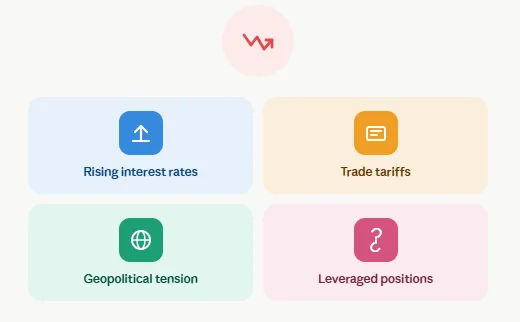
When these pressures stack up together, money moves out of crypto fast. And since crypto trades around the clock with no circuit breakers or trading halts, those drops can happen overnight.
Why altcoins fall harder than Bitcoin
Newer investors often expect everything to fall equally during a crash. That’s not how it works. In early 2026, Bitcoin dropped hard, but Ethereum lost even more ground in percentage terms that same week. Dogecoin and XRP? Even steeper single-day drops.
Bitcoin is the largest and most established name in the market. It acts as the anchor. Smaller coins have thinner trading volume, which means when a wave of selling hits, there aren’t enough buyers on the other side to absorb it. The price falls faster and further.
The domino effect nobody warns you about
A lot of newer investors don’t know this: many traders borrow money to buy crypto. It’s called leverage. Once prices fall below a certain point, those borrowed positions get force-closed automatically. That sends another wave of sell orders into the market, prices drop further, and more closures get triggered on top of that.
That’s a liquidation cascade. It’s why crashes can go from bad to catastrophic within hours, even when whatever started it didn’t seem like a big deal at the time.
Exchange risk is real
During a crash, the platform where someone stores their crypto can become a risk of its own. In past downturns, some exchanges froze withdrawals or collapsed entirely, leaving users locked out of their funds.
The FTX collapse in 2022 wiped out billions in customer money. It’s a risk that gets ignored in good times but becomes very real when markets are under pressure.
How to survive crypto market crash
Surviving a downturn isn’t about being the best trader. It’s mostly about avoiding the moves that make things worse. A crash doesn’t feel like a temporary dip while it’s happening. It feels permanent. That’s the psychological trap that costs investors the most.
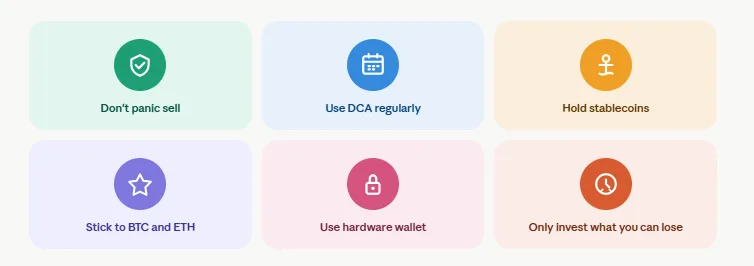
Don’t panic sell
The most common and costly mistake during a crash is panic selling. When a portfolio is down significantly, the instinct is to get out fast and stop the bleeding. But selling during a crash locks in that loss permanently.
Every major crypto market crash in history has been followed by a recovery. Bitcoin has survived drawdowns of over 80% before and bounced back each time. That doesn’t mean it’s guaranteed to repeat, but it’s worth pausing before making a fear-based decision.
If checking the portfolio every hour is causing stress, stepping away from the charts for a while is a completely valid move.
Dollar-cost averaging (DCA)
DCA is one of the most beginner-friendly approaches to investing in crypto, especially during volatile stretches. The idea is simple: invest a fixed amount at regular intervals, regardless of what the price is doing.
Say someone puts in $50 every week. When prices are low, that $50 buys more. When prices are higher, it buys less. Over time, the average cost of holdings levels out naturally. There’s no need to predict the bottom or time anything perfectly.
The point of DCA is to remove the need to make a perfect decision. There is no perfect decision in a crash. Years of backtesting data show that disciplined DCA into Bitcoin has historically delivered strong returns, even for investors who started right before a crash hit. Consistency matters far more than timing.
Keep some in stablecoins
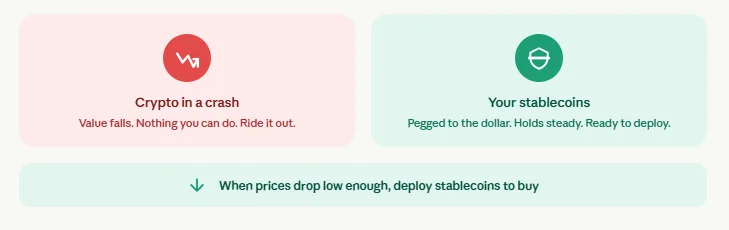
Stablecoins are crypto assets pegged to the dollar, like USDC or USDT. One dollar in equals one dollar out, no matter what the rest of the market is doing.
Holding a portion of a portfolio in stablecoins means that chunk doesn’t fall with everything else. It also creates what traders call “dry powder,” meaning funds that are ready to deploy when prices drop to attractive levels.
During the 2026 downturn, the total stablecoin market surpassed $310 billion, showing just how many investors were using exactly this approach.
Stick to Bitcoin and Ethereum first
For anyone working out how to survive a crypto market crash, asset selection is one of the most important decisions. Bitcoin and Ethereum are the only major cryptocurrencies that have recovered from every single historical downturn, including the 2018 crypto winter, the 2020 COVID crash, and the 2022 FTX collapse.
Smaller, newer coins might look cheap during a crash. But cheap doesn’t mean safe. A lot of altcoins don’t survive bear markets at all. For a beginner, staying focused on the top two is the lowest-risk path through a downturn.
Move crypto off exchanges
A hardware wallet is a physical device that stores crypto offline, completely separate from any exchange. If an exchange collapses or gets hacked, funds on a hardware wallet stay safe. It’s one of the simplest steps for any long-term holder, and one of the most commonly overlooked.
Only invest what can actually be lost
A crypto allocation should never include money needed for rent, bills, or emergencies. If a sudden significant drop would create a real financial problem, the position is too large. This is one of the most practical parts of knowing how to survive crypto market crash situations without the emotional and financial damage that comes from overexposure.
The bigger picture
A crypto market crash is hard to sit through. The 2026 downturn has been one of the steeper ones in recent years, and the discomfort is real for anyone holding positions in the red. But historically, bear markets have also been the period when long-term investors build their strongest positions.
It’s not about calling the bottom or being clever. It’s about staying disciplined, keeping exposure manageable, and understanding that crashes aren’t endings. They’re part of the cycle. The investors who come out the other side aren’t always the fastest to react. They’re usually the ones who kept their heads when everyone else didn’t.