


Ethereum is holding its ground – for now. Trading around $2,365, the asset has managed to stay above its short-term moving averages, a sign of near-term strength that would normally reassure traders. But beneath that surface stability, a much more aggressive battle is playing out, not in spot markets, but in derivatives.
Ethereum market leaning the wrong way?
Zooming out, the global picture is unusually one-sided. Open interest across all exchanges has climbed to roughly $16.3 billion, sitting well above its recent average. At the same time, funding rates remain negative.
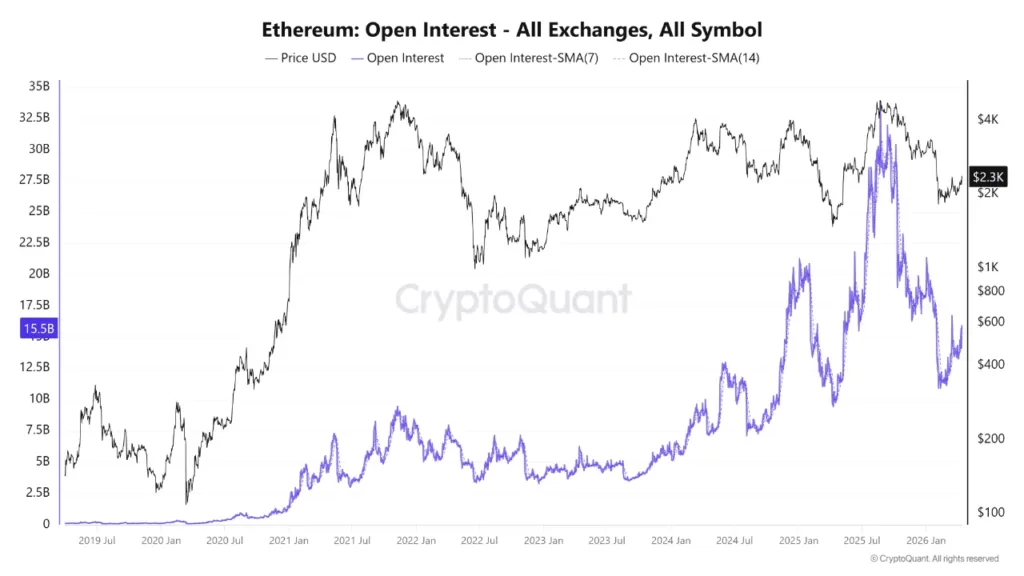
In simple terms, that means the majority of traders are betting against Ethereum’s rally – and are actively paying to hold those short positions.
That kind of setup tends to create tension. When the market leans too heavily in one direction, it usually sets the stage for a strong reverse movement.
In the current case, ETH’s ability to hold its own while so many traders are waiting for a drop suggests that the downside conviction isn’t leading to real price weakness – at least not for the time being.
Binance becomes the battleground
The more interesting story, however, emerges when you zoom into Binance, which has become the focal point of this tug-of-war.
Open interest on the exchange has increased to just over $6 billion, responsible for a significant chunk of the global total. More notably, it jumped more than 10% in just 24 hours – a clear signal that new capital is entering the market, and doing so aggressively.
But here’s where things diverge. While the broader market is leaning short, Binance funding rates have flipped positive. That means traders on the largest exchange – Binance – are largely positioned on the long side, convinced that ETH will continue to move upwards.
This split creates a rare and unstable dynamic. On one side, you have a global market expecting a pullback. On the other, you have a concentrated pocket of leveraged buyers pushing the opposite narrative.
When both sides are heavily positioned, it doesn’t take much to trigger a cascade.
A powder keg waiting for direction
What this ultimately creates is a market imbalance that can have real consequences for participants. Close to 40% of Ethereum’s open interest is now concentrated on Binance, meaning a large portion of the market’s risk sits in one place.
That concentration alone increases the chances of a sharp, localized move spilling over into the broader market. There are two paths from here, and neither is quiet.
If Ethereum continues to surge higher, the global shorts could start to unwind, triggering a short squeeze that hastens the rally. But the opposite risk is just as real.
With Binance traders piling into leveraged longs at elevated levels, any failure to break higher could send the price lower in search of liquidity—forcing those late buyers out of their positions.
In other words, the market isn’t lacking direction—it’s lacking resolution. Both sides are heavily committed, and whichever group blinks first will likely define the next major move.
For now, Ethereum is holding the line. But the pressure building underneath suggests it won’t stay this balanced for long.