



Polkadot (DOT) prices have slipped below the multi-year descending channel and have reached a high-risk accumulation zone. Last time DOT prices crashed by nearly 98%, there was a 4000% rally that followed. As a result, the DOT community is closely monitoring whether to enter the market or remain cautious at this critical juncture.
DOT price falls by 98% from all-time high
A technical analyst who goes by the pseudonym Crypto Patel observed that DOT prices have fallen by 98% from an all-time high of $55 back in 2021. When considering the higher time frames, the token is currently residing in a high-risk accumulation zone. As this was the same structure that preceded a 4000% rally, the investors are tentative and are waiting for the slightest of signals to enter the market.
First, a prolonged downtrend tends to exhaust sellers. Early in the move, every bounce gets aggressively sold, but as price keeps making lower lows for months or years, the pool of willing sellers starts drying up. Those who wanted to sell have mostly already done so. That’s when you begin to see weaker follow-through on new lows.
At the same time, value starts to attract buyers. Long-term participants (institutions, patient capital) don’t chase price—they accumulate when assets are deeply discounted. So near the lower boundary of a multi-year channel, you often get quiet accumulation, even if price still looks weak on the surface.
In such a context, Crypto Patel seems to be giving some hints that the descent might be over and the price could appreciate. In the X post, Patel, even after a multi-year channel compression near demand, the prices are still below the lower trendline of the downtrend channel.
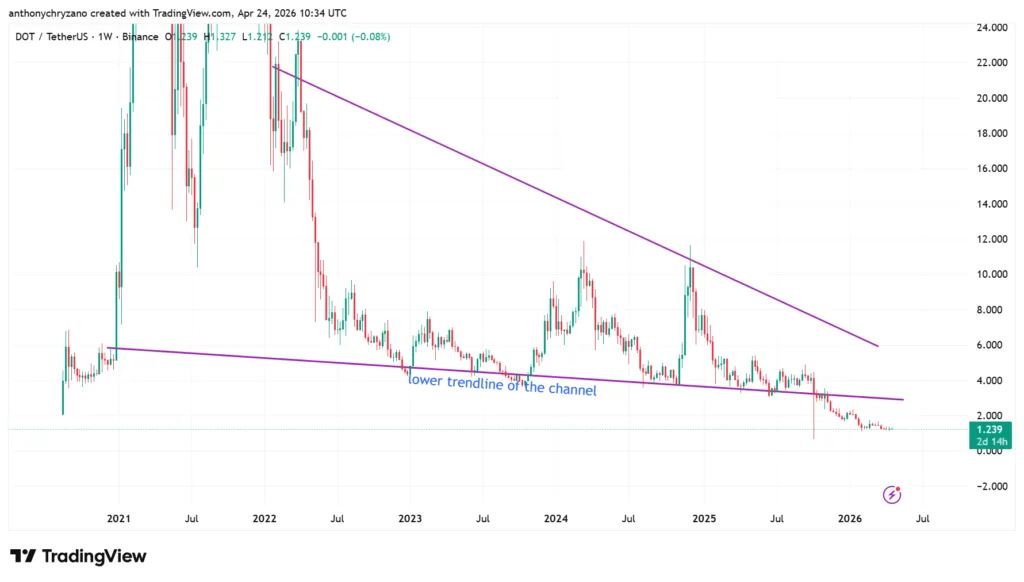
When a multi-year descending channel compression near a demand zone occurs, it indicates that the asset has been in a prolonged downtrend, consistently moving within a downward-sloping channel where lower highs and lower lows are contained between parallel resistance and support lines.
Over time, the price action is now tightening or compressing. indicating reduced volatility as it approaches a key historical demand area where buyers have previously stepped in.
Nevertheless, even though there was such a decline in the price, it still remains below a significant bearish breakdown point that initially acted as support but then became resistance after the breakout.
It creates an important technical situation when price consolidates between support and resistance levels. The only thing that matters now is which side prevails and pushes the price in the desired direction.
This is a critical zone for DOT. If it reclaims and holds above the $2.35 level, the case for a bullish structure shift and breakout validation will be confirmed.
To see what is going on with the DOT prices at the present, we might need to take a close look. This could confirm if the price would reclaim and hold above the $2.35 price level.
Will DOT claim and recover the $2.35 resistance level?
As shown in the chart below, DOT is trading inside a broadening wedge. A broadening wedge is basically the opposite of compression.
Instead of price tightening, it expands outward, making higher highs and lower lows at the same time. The trendlines diverge, forming a megaphone shape, which tells you one thing clearly: volatility is increasing and the market is getting more chaotic.
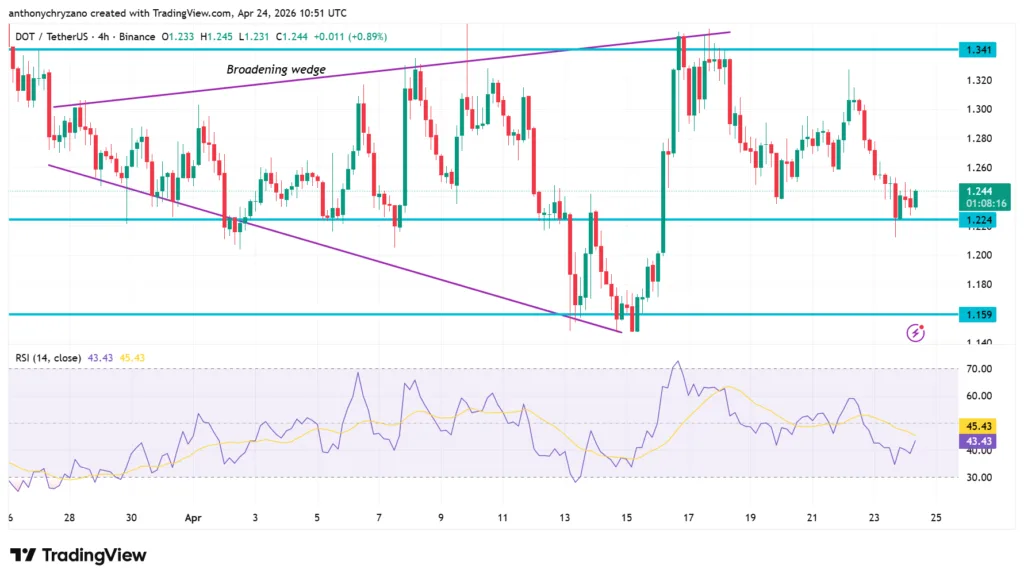
Inside this structure, price action becomes erratic. Buyers push price aggressively upward, but sellers quickly take control and slam it down even harder, creating wide swings.
This usually reflects a market where there’s no clear consensus—participants are reacting emotionally rather than building a steady trend. Liquidity gets swept on both sides, and both bulls and bears get trapped repeatedly.
DOT is currently in the middle of heading towards the lower trendline after rebounding off of the upper trendline. And since it is currently midway between both of these trendlines, DOT might further fall to $1.15 as it completes a rebounding action. This movement is just part of the behavior of the price inside the falling wedge.
However, as the wedge is incomplete, it is very difficult to say whether DOT will be able to recover the $2.35 resistance level.
However, based on the relative strength index indicator, which indicates whether the price is overvalued or undervalued, DOT appears to be in a precarious position as the RSI has been consistently making lower lows and lower highs.