

Nobody tells you that the safest tool in your trading kit might also be the tastiest meal you are unknowingly serving to the market. A stop loss in crypto is supposed to protect you. In theory, it is your emergency exit, your financial fire door.
In practice, it quietly becomes the fuel powering someone else’s trade. Welcome to the world of crypto market structure, where your protective order is someone else’s opportunity, and a stop loss in crypto means something far richer than any beginner tutorial covered.
Grab a coffee. This will make you rethink everything.
When price hunts your stop
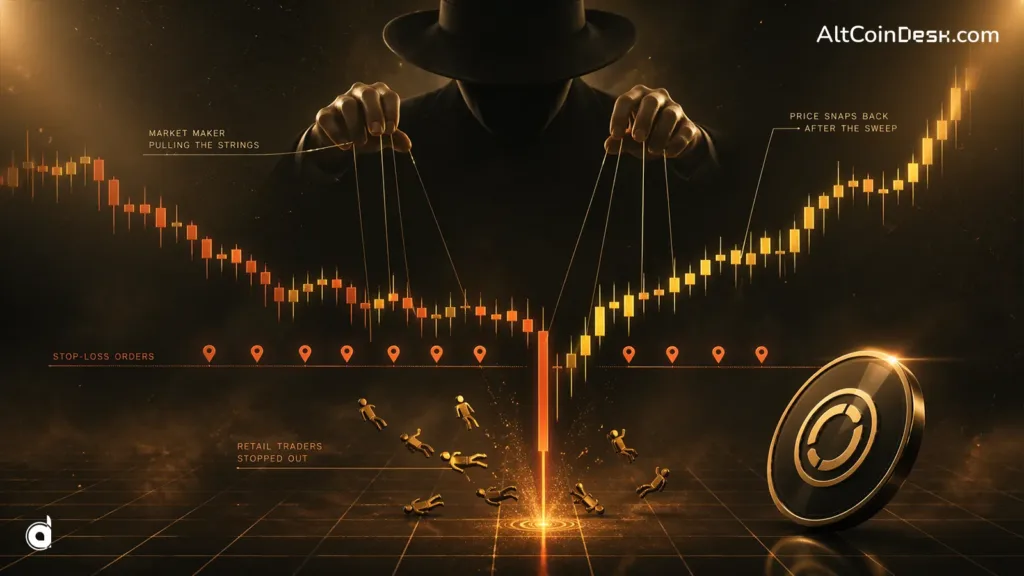
Let us skip the conspiracy board and the red string connecting shadowy figures. The truth is less dramatic and somehow more interesting. When you set a stop loss in crypto, it sits like a trap door. The moment the price touches your level, that stop becomes an aggressive market order and executes immediately, without negotiating.
Now imagine thousands of retail traders doing the exact same thing: stops just below a round number, just under a visible swing low, just beneath a trendline that everyone and their trading group has drawn. You do not have one trap door. You have an entire trapdoor floor. When price slips into that zone, it triggers a cascade.
Each triggered stop becomes a sell order that pushes the price lower, which triggers the next stop, which pushes the price lower still. That is not manipulation in the comic book sense. That is market structure doing what market structure does, seeking the path where the most liquidity lives. Setting stops at predictable levels is essentially volunteering your order as part of that process.
The pattern looks like hunting because it repeats, and it affects every trader using a stop loss in crypto near visible technical levels. The mechanism, though, is closer to an auction searching for counterparties than a villain twirling a mustache.

What market makers really do
Here is where people get loudest on crypto Twitter and also most confused. Market makers are not omnipotent overlords. They quote bids and asks, earn the spread, and manage their inventory in real time. When buying pressure builds, and they find themselves too short, they raise offers.
When selling piles in, they lower the bids. They are constantly adjusting, not dictating, and they read liquidity concentrations faster than any retail trader can. The October 2025 crash gave everyone a masterclass. Market depth collapsed by more than 80% across major exchanges within minutes, and many market makers widened spreads dramatically or stepped away as volatility spiked. Others, more soberly, called it a predictable risk management response from firms with no obligation to absorb losses on your behalf.
During that crisis, the inability to process a stop loss order on certain platforms triggered waves of margin calls and forced liquidations, with BTC top-of-book liquidity shrinking by over 90% on key venues. Your carefully placed stop loss in crypto, in that environment, was not just at risk of being swept. It was at risk of not executing at any reasonable price. That is the grimmer, less-discussed side of this story.
Liquidity is your real map
Think of the market as an ocean, not a line on a chart. The line is a drawing. The ocean is real, and it moves toward wherever the fish are gathered, which in trading means wherever orders are clustered.
Equal highs and equal lows on your chart are not just pretty patterns. They are signposts that say “stops are here.” Round numbers like $80,000 on Bitcoin or $3,000 on Ethereum attract crypto stop loss orders the way a street food cart attracts a lunch crowd.
Prior session highs and lows, trendline touches, and obvious support zones all collect orders from traders who learned the same charting lessons from the same YouTube channels. When enough orders stack at a predictable level, they become a destination, not a coincidence.
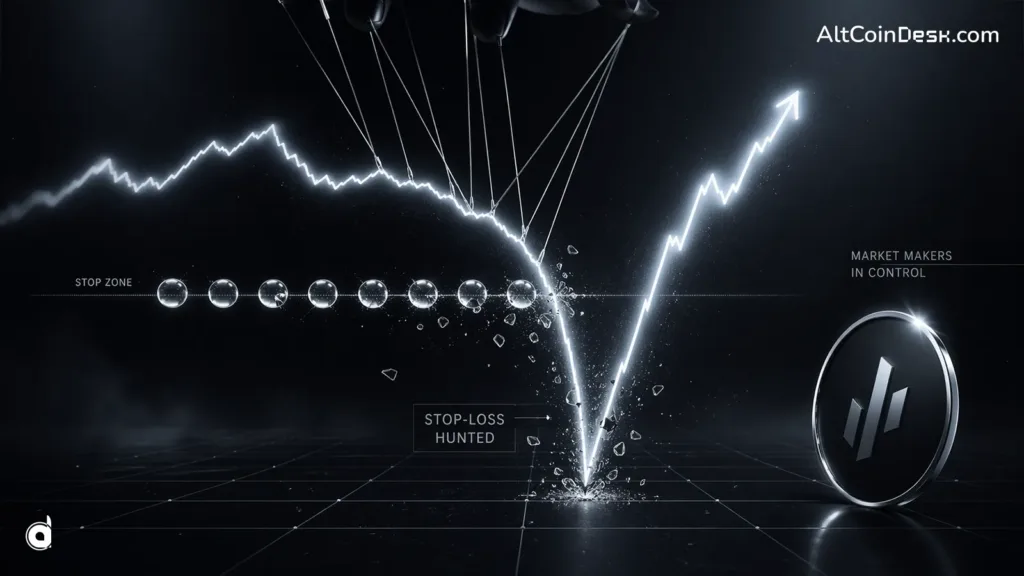
This is what ICT concepts call a liquidity grab. Institutional flow, or aggressive algorithmic routing, moves price into the zone, collects the liquidity those stops provide, and reverses once the imbalance is cleared. Understanding this is how you start using a stop loss in crypto more intelligently than 90% of the market does. Whether that is calculated intent or emergent market structure does not change your experience when you stop fires, and price immediately bounces back without you.
The 2025 crash is live proof
If there was ever a live demonstration of how a stop loss in crypto, leverage, and liquidity interact under real stress, it happened in October 2025. Open interest fell by more than $70 billion in days, and each wave of selling triggered the next, sweeping up even carefully placed stops in a mechanical avalanche.
After the dust settled, order book depth across major centralized exchanges remained structurally lower, with BTC average cumulative depth at 1% from mid-price, declining by nearly one third. Thinner markets mean future liquidity sweeps become more likely, not less, because every push into a stop cluster gets amplified. The aftershocks created conditions where setting a stop loss in crypto became more precarious, not safer.
What stop placement reveals
Placing a stop directly under a round number or exactly at a swing low is the trading equivalent of wearing a neon sign that says “I learned from the same tutorial as 40,000 other people.” It is not wrong. It is just predictable. And predictability in markets is rarely your friend.
The more useful skill is treating stop placement as a structural decision. Ask not where the chart looks tidy. Ask where the price would genuinely need to go to prove your trade idea wrong. That is often one ATR, or average true range, beyond the obvious level rather than sitting flush against it. This extra buffer is not cowardice. It is an acknowledgment that market structure will test the level before respecting it.
Traders who survive long-term size positions before picking stop locations. A smaller position with a wider stop loss in crypto is almost always more durable than a large one placed exactly where everyone else has theirs.
Chart signals of a sweep
Long wicks at key support or resistance zones are the market leaving fingerprints. When price spikes below a visible low, triggers a cluster of stops, and closes back above the level within the same candle, that is the pattern. Add a volume spike during the wick and a quick reversal with no follow-through, and you have the full signature of a stop loss sweep in crypto.
False breakouts work the same in reverse. Price punches above resistance, buy stops fire, a burst of buying occurs, and then price slides back below the level as though nothing had happened. The volume surge confirms the stop cluster was consumed. These patterns repeat because human psychology clusters orders predictably.
The lesson buried in the chaos
The takeaway here is not to abandon your stop loss in crypto trading. Please do not do that. It remains the most essential risk management tool a retail trader has access to.
The lesson is to use your crypto stop loss with more structural awareness. Place stops where your trade thesis actually breaks down, not where the chart looks neat. Give yourself a buffer beyond the obvious level. Watch for wicks, volume spikes, and false breaks as signals of liquidity being consumed rather than trend direction changing. Size positions so that a stop being hit is an inconvenience, not a catastrophe.
And the next time price sweeps your level and immediately reverses without you on it, resist the urge to call it a conspiracy. It was the market finding liquidity where it was concentrated, because that is almost always what actually happened. Using a stop loss in crypto is not a mistake, but using one without understanding liquidity structure is. The stop loss in crypto is not your enemy. Treating it like a magic shield without understanding the mechanics behind it is foolish.